
Is a 2x ROAS Good or Bad? It Depends on a Number You Have Probably Not Calculated
 Digital PratikGrowth Marketing Consultant
 There is no universal answer, and that is the actual answer.
A 2x ROAS is excellent for one business and bankrupting for another, because it depends entirely on your margin.
What matters is your break-even ROAS, the return at which you neither make nor lose money once costs are taken out.
Calculate that number once, and a 2x becomes obviously good or obviously bad in about ten seconds.
Chasing 4x because somebody on the internet said 4x is how businesses die profitably.
This is one of the most common questions I get asked, and it is almost always asked in a way that cannot be answered. Is 2x good?
I do not know. Nobody does, including the person asking, until one number gets worked out.
Once you have that number, the question stops being interesting, which is the point. It becomes a rule you follow instead of a debate you have every Monday.
What ROAS is, and what it quietly leaves out
Return on ad spend is revenue divided by advertising cost. Spend one thousand, make two thousand back, that is a 2x.
It is a useful number and it is a partial one.
What it leaves out is everything that is not ad spend. Cost of delivery, staff, software, payment fees, refunds, tax.
ROAS is a revenue ratio, and revenue is not the thing that keeps a business alive.

Your break-even ROAS
This is the number to calculate, and it takes one line. Divide one by your gross margin, expressed as a decimal.
That gives you the ROAS at which the advertising exactly pays for itself.
| Gross margin | Break-even ROAS | Is a 2x good? |
|---|---|---|
| 70 percent | About 1.43x | Yes, comfortably profitable |
| 50 percent | 2.0x | Exactly break-even, no profit |
| 25 percent | 4.0x | No, losing money on every sale |
Three businesses, one identical ROAS, three completely different situations. That is why a benchmark from somebody else's business is worse than useless.
Put your own margin in and redo this table for yourself, because the only row that matters is yours.
Why a low ROAS at scale can beat a high one
Here is the trap that keeps small businesses small. A founder proudly holds a 5x return on a tiny budget, because every time they increase spend the return drops, so they stop.
The return stays beautiful and the business stays the same size.
Do the arithmetic with round numbers. A 5x on two thousand a month of spend produces ten thousand of revenue.
If the margin is 50 percent, that is five thousand of gross profit and three thousand of it went on ads, so two thousand is left.
Now take a 2.5x on twenty thousand of spend. That is fifty thousand of revenue, twenty-five thousand of gross profit, twenty thousand on ads, five thousand left.
Half the return, more than double the profit. Put your own numbers through the same two lines before you decide which one you would rather have.
Set a base ROAS and let it make the decision
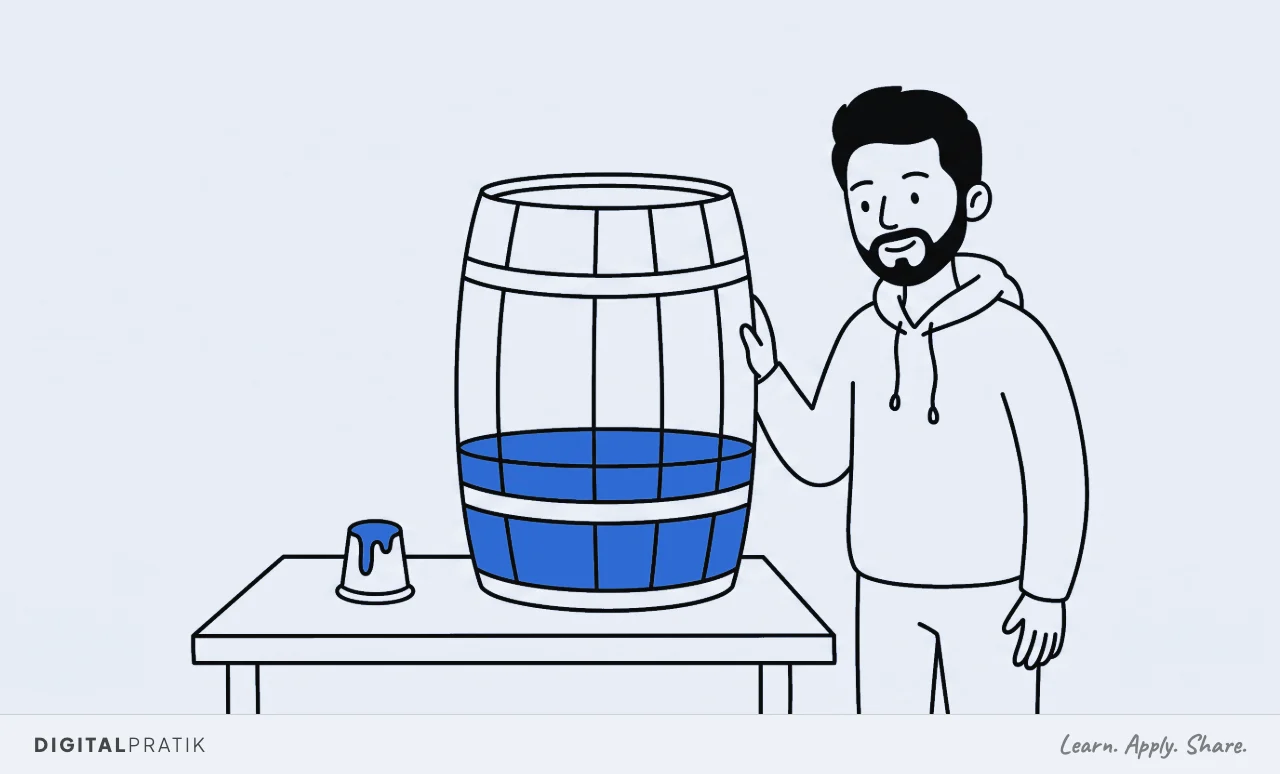
Once you know break-even, set a base ROAS slightly above it. That is your line.
Above the line, you increase budget. Below it, you decrease.
The decision stops being a judgement call you make while tired.
The reason to write it down is that everybody's instincts get worse as spend increases. A rule set on a calm Tuesday is better than a decision made on a bad Friday.

How far above break-even to set it is a judgement about how much room you want between the campaign and the cliff. Sit it too close and an ordinary bad week tips you into losing money before the rule reacts.
Sit it too far above and you throttle spend that was actually working. Somewhere modestly above break-even leaves room for a wobble without leaving profit on the table, and the exact figure should come from how volatile your own account has been over the last quarter rather than from anybody else's.
Judge it on three days, not on yesterday
This is the discipline that saves the most money. A single day tells you almost nothing.
Traffic is lumpy, delayed conversions are real, and one large order distorts everything.
Take a rolling three-day average and compare that to your base. Above it, increase the budget by a modest step, something like twenty percent.
Below it, come down. Then do it again tomorrow.
Small, frequent, rule-based moves beat large, occasional, emotional ones.
Reading about a system and running one are different jobs. If your business does AED 10 million a year or more, this is what a working session looks like.
Do not read the number off the platform
The reported ROAS in your ads manager is a modelled figure built from partial data, and it is produced by the party you are paying. That does not make it a lie.
It makes it a claim.
Track revenue where money actually arrives, in your payment processor or your own sheet, and calculate the ratio yourself. The two numbers will differ, sometimes considerably, and the one from your bank is the one to run the business on. True ROI versus reported ROAS goes through how to set that up properly.
The one that actually ruins the number
Platforms credit the last click. A real buying journey often runs across several ads over days, one that opened the loop, one that built trust, one that broke the objection, and one that collected the money.
Only the last one gets the credit.
So the ads with a poor reported ROAS are frequently the ones doing the work that made the winning ad possible. Kill them on the number and the winner degrades a fortnight later for reasons nobody can find.
That specific mistake is expensive enough to have its own article.
When ROAS is the wrong metric entirely
If the sale happens on a call, or the client stays for a year, or the first purchase is deliberately unprofitable, ROAS is measuring a slice of something and reporting it as the whole.
For most service businesses the pair that matters is lifetime value against acquisition cost, and how long the payback takes. A 1.2x on the first transaction is fine if the client is worth many times that over two years and you can fund the gap. LTV to CAC and the payback window are the two to read next.
So: is 2x good or bad?
It is good if your break-even is below it, you are measuring from your own revenue rather than the platform's, you are judging on a three-day average, and the spend is large enough for the profit to matter.
It is bad if your break-even sits above it, or if you genuinely do not know what your break-even is. And if you do not know, that is the work for this week.
It takes one line of arithmetic and it changes every scaling decision you make afterwards.
Frequently asked questions
It depends entirely on your gross margin. At a 70 percent margin your break-even is roughly 1.43x, so a 2x is comfortably profitable. At a 50 percent margin, 2x is exactly break-even. At a 25 percent margin your break-even is 4x, so a 2x is losing money on every sale. Calculate your own break-even before judging any return.
Divide one by your gross margin expressed as a decimal. A 40 percent margin is 1 divided by 0.4, which is 2.5x. That is the return at which advertising exactly pays for itself and you make nothing. Set your working target above that number, and treat anything below it as a campaign that is costing you money.
The platform reports a modelled figure built from partial data, using its own attribution window and crediting itself generously. Your payment processor reports money that actually arrived. Both are doing what they were designed to do, but only one of them can pay salaries. Run the business on the second.
No. A very high return usually means spend is too low. Profit is what you keep, not what ratio you achieved, and a lower return on much larger spend often produces far more profit than a spectacular one on a tiny budget. Scale profit, and use ROAS as the guardrail that stops scaling from becoming unprofitable.
Judge on a rolling three-day average rather than on a single day, and move in small steps of around twenty percent when you are above your base. One day of data is mostly noise, and large emotional jumps in either direction cause more damage than they fix.
Install this in your business
An article gives you the map. A working session gives you the system, built around what you actually sell and who actually buys it.