
Fix Your Delivery System Before You Buy More Leads: The Growth Math Service Founders Get Wrong
 Digital PratikGrowth Marketing Consultant
 Fix your delivery system before buying more leads. Capacity is the silent killer in every service business. More leads poured into a broken or person-dependent delivery process does not create growth.
It creates chaos.
The math also changes when humans deliver your service: the minimum LTV:CAC ratio you need before scaling safely is higher than most founders realize.
Systematize your best person's process first, then scale acquisition.
That is the order that actually compounds.
Most service founders treat growth like a volume problem. Get more leads, close more clients, hire more people, and the revenue will follow.
Except it does not. What follows is more clients, more staff, more fires, and the same bank balance.
The business gets busier. The founder works longer hours.
But the profit does not move. That is not a lead problem.
That is a delivery problem.
The Three Problems in Any Service Business
Every service business has exactly three problems. Acquisition is getting leads. Conversion is turning those leads into paying clients. Capacity is delivering the result without drowning. Everything else is a symptom of one of these three.
The trap is spending all of your energy on acquisition and conversion, then wondering why growth feels like running on a treadmill. The capacity side, the actual delivery, the systems, the process, gets ignored until it breaks.
And by the time it breaks, you have already sold more than you can properly serve.
Capacity Is the Silent Killer
Capacity does not announce itself loudly. A dried-up pipeline is obvious.
A conversion rate that tanks is obvious. But a delivery system that is quietly eating your profit and your team's energy?
That one hides. It hides inside the hustle narrative.
It hides inside the feeling of being in demand. A full calendar feels like success.
It is not always success. Sometimes it is just a very expensive job with your name on the door.
The founder who works 70 hours and takes home less than their best team member is not building a business. They are building a bottleneck.
Capacity is the problem that shows up last but causes the most damage.
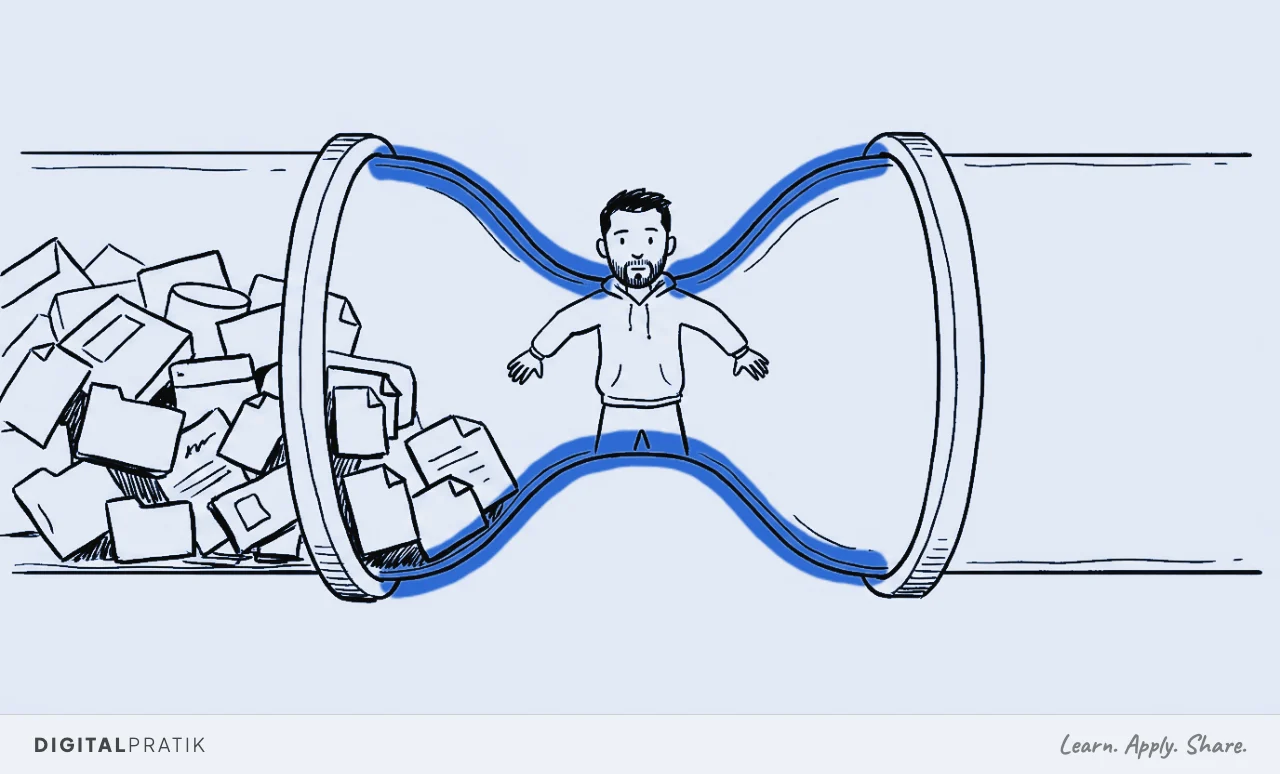
What Happens When You Pour More Leads Into a Broken System
Here is what more leads actually do when delivery is not systematized. Each new client gets a slightly different version of your service, because the process lives in whoever picks up the work that day.
Quality becomes inconsistent. Clients who expected one thing get another.
Referrals slow down. Your best team members burn out because they are the ones holding the whole operation together.
And the founder ends up back in the delivery personally, fixing what the system could not. You did not scale.
You just added more surface area for things to go wrong. Most growth problems in service businesses trace back to this one mistake.
The Math Changes When Humans Deliver
There is a framework I use to check whether a business is ready to scale. It looks at how many humans are in the loop across three functions: attraction (how people find you), conversion (how they pay you), and delivery (how they get the result).
Each human in the loop raises the minimum LTV:CAC ratio you need before scaling is safe. A fully automated business, ads to a checkout page for a software product with no human involved in delivery, can operate at a lower ratio.
The moment a person delivers the result, that ratio has to be higher. Add more humans across more parts of the process and the number climbs further.
Most founders never run this math. They just increase ad spend and hope the numbers work out.
| Humans in the loop | Example | Minimum LTV:CAC |
|---|---|---|
| 0 (fully automated) | Ads to checkout, software delivers the result | 3:1 |
| 1 human in delivery | Ads to checkout, a person delivers the result | 6:1 |
| 2 or more | Manual outreach, a call to close, a person delivers | Higher still |
Confused Busy With Rich
The busiest service founders I have spoken with are often the least profitable per hour. They confused activity with outcome.
A packed calendar looks like proof the business is working. But if every hour of output requires a personal hour of input from the founder or a senior team member, the business has no ceiling.
It is capped by human hours. You cannot buy more hours.
You cannot clone your best person. And you cannot scale a service that only works when one specific individual is doing it.
Scaling profit without scaling headcount means attacking the capacity problem with systems, not with more people.
What Systematizing Delivery Actually Looks Like
Systematizing delivery is not about building complicated software or writing a 200-page manual. It is about one thing: making your best person's process repeatable without requiring that specific person.
In practice, that means three things.
- Document the real process. Not the process you wish existed. The actual steps your best person takes, in the order they take them, including the decisions they make along the way.
- Identify the judgment calls. Some steps are mechanical and can be handled by anyone. Others require a real decision. Separate them. Build a simple guide for the judgment calls so a second person can make the same call your best person would.
- Test it with a different person. Hand the documented process to someone who did not build it and watch where it breaks. Where they get stuck is where your documentation is incomplete. Fix those gaps before adding volume.
Reading about a system and running one are different jobs. If your business does AED 10 million a year or more, this is what a working session looks like.
Your Best Person Is Already the Template
You do not need to invent a new process. You almost certainly already have one.
It lives inside the head of your best team member, or inside your own head if you are still doing the delivery yourself. The process that produces the best results for clients consistently, that is the one to document and replicate.
Watch how they work. Ask them to walk you through every step out loud while you take notes.
Record the delivery conversations. Map the workflow.
The goal is not to copy a person. The goal is to capture a process.
Once it is documented and in the business, it belongs to the business, not to one individual. A business that owns its process can train anyone to execute it.
That is how a service business stops being a job and starts being an asset.

The Discipline of Saying No at Capacity
One of the clearest signs that a delivery system is working is when the business can say no. Not reluctantly, not apologetically. Just plainly.
We are at capacity right now. We do not take on new clients past our current limit because the result suffers when we do.
That is a standard worth holding. It is also a signal to the market.
A business that protects its delivery standard earns trust and earns referrals. A business that says yes to everything, then delivers inconsistently, trains the market to see it as a commodity.
Standards around capacity are a sales asset, not a liability.
How to Know Your Delivery Is Ready to Scale
Before increasing lead volume, answer these questions honestly. If most of them are not true right now, fix delivery first.
- The process is documented. Someone other than the founder or your best team member can follow it and produce the same result.
- The result is consistent. Your last ten clients had roughly the same experience and outcome, not a different version depending on who handled the work.
- The team knows the ceiling. Everyone involved knows how many clients can be served at full quality right now. The founder is not doing that math alone in their head.
- Onboarding is defined. A new client knows exactly what to expect after they say yes: who they will hear from, when, and what the first step is.
- The LTV:CAC ratio clears the minimum. Based on how many humans sit in your delivery loop, your current ratio gives you room to increase acquisition spend without going negative.
The Business That Compounds
A service business with a systematized delivery does something a chaotic one cannot. It compounds.
Every client served well becomes a referral source. Every team member trained on the documented process becomes a force multiplier.
Every new lead enters a machine that produces a consistent result, which means the reputation keeps improving without the founder being personally present for every delivery. That is what a service business ready to scale actually looks like.
Not more hustle. Not more ad spend.
A process that works the same way every time, by design, not by luck. If you want help building that for your business, see how we work together.
Frequently asked questions
A capacity bottleneck is when the business cannot deliver more results without adding more of one specific person's time, usually the founder or a key team member. The delivery process depends on a person, not a documented system. When more leads come in, quality drops or the bottleneck person burns out, and the founder often ends up back in the delivery personally to fix what slipped.
Your delivery is ready to scale when someone other than you or your best team member can follow the documented process and produce a consistent result. Your last several clients should have had the same experience regardless of who handled the work. Your team should know the capacity ceiling, and your LTV:CAC ratio should clear the minimum threshold for the number of humans in your delivery loop.
Productizing service delivery means turning your best person's process into a repeatable system the business owns, not one that lives in one individual's head. You document the real steps, define the decision points, test it with a second person, and fill the gaps where they get stuck. The result is a service that delivers consistently regardless of who executes it, which is what makes the business scalable without burning out your best people.
Leads feel active and measurable. More leads means more calls, more proposals, more motion. It looks like growth in the moment. Delivery problems are quieter. They show up as exhaustion, inconsistent client outcomes, and flat profit despite a full calendar. Most founders only fix delivery after a bad enough breakdown forces them to stop and look at the real problem.
The LTV:CAC ratio tells you whether the lifetime value of a client covers the cost to acquire them, with enough margin to scale safely. In service businesses where humans handle the delivery, the minimum ratio required before scaling is higher than in fully automated businesses. More humans in the loop means higher delivery costs and more operating risk, so the ratio has to support that before you increase lead volume.
Install this in your business
An article gives you the map. A working session gives you the system, built around what you actually sell and who actually buys it.