
The 9-Step Framework for Deploying Agentic AI in a Solar Installation Business
 Digital PratikGrowth Marketing Consultant
 A solar installation company deploys agentic AI in nine steps across three phases.
Before you build, you diagnose what leaks, jobs stalled before compliance, finished installs never invoiced, hours lost chasing DNO approval and paperwork, then shadow one job from enquiry to commissioning and write the procedure down, including the MCS, DNO and building control gate.
Then you build a command center, turn the procedures into searchable data, and add a site controller under strict safety rules.
Then you remove yourself.
Here is the part nobody says to the founder of a solar installation company out loud. Somewhere between your first van and a full order book, you stopped being the installer and became the operating system.
Every enquiry, every survey, every quote, every DNO application, every "has that job passed its checks yet", every customer chasing a start date waits on your attention, which means the whole firm runs exactly as fast as one person can read.
This is the framework we use to take that job off the owner and give it to a system, without the risk that comes with letting software anywhere near a grid connection, a roof and a customer's money. It is nine steps in three phases.
Four before you build anything, three to build it, and two to do the thing the whole exercise is for, which is to remove yourself from the middle of every job.
It is worth saying what this is not. It is not a new job-management package, and it is not "let AI install the panels".
The certification and the electrical judgement stay with your qualified people, and they always will. What changes is that the reading, the quoting, the chasing, the filing and the paperwork stop landing on one desk, so a job never stalls because somebody was buried in DNO forms the week three surveys came in at once.
You quietly became the operating system
It happens slowly. In the early years you surveyed the roof, sized the system, priced it, filed the grid application and rang the customer yourself, because there was nobody else and you were good at it, so the firm grew.
Then it kept growing and the routing never left your head, because it was faster to just do it than to write it down. Now you are the one who remembers a customer is still waiting on a quote, who notices a job cannot be booked until the DNO comes back, who spots that a finished install was signed off weeks ago and never invoiced.
None of that is written down anywhere. It lives in your attention, and in an installation business attention is the scarcest thing there is.
Three things follow, and every one of them costs the firm real money.
- The firm runs at reading speed. An owner spending two or three hours a day reading enquiries, pricing jobs by hand and chasing where each install has got to is normal. That is not installing work. It is triage, done by the one person the whole business already depends on.
- Jobs go live because somebody remembered the checks. Which is fine until the busy week nobody did. An install commissioned before its MCS certificate, or connected before the DNO said yes, is not a small slip. It is unsafe, it is uncertifiable, and it is the kind of thing that ends a firm.
- Nothing survives your holiday. A firm where one person is the router does not pause when that person is away. Quotes go out late, applications sit unfiled, finished jobs go unbilled, and you find out when you get back.
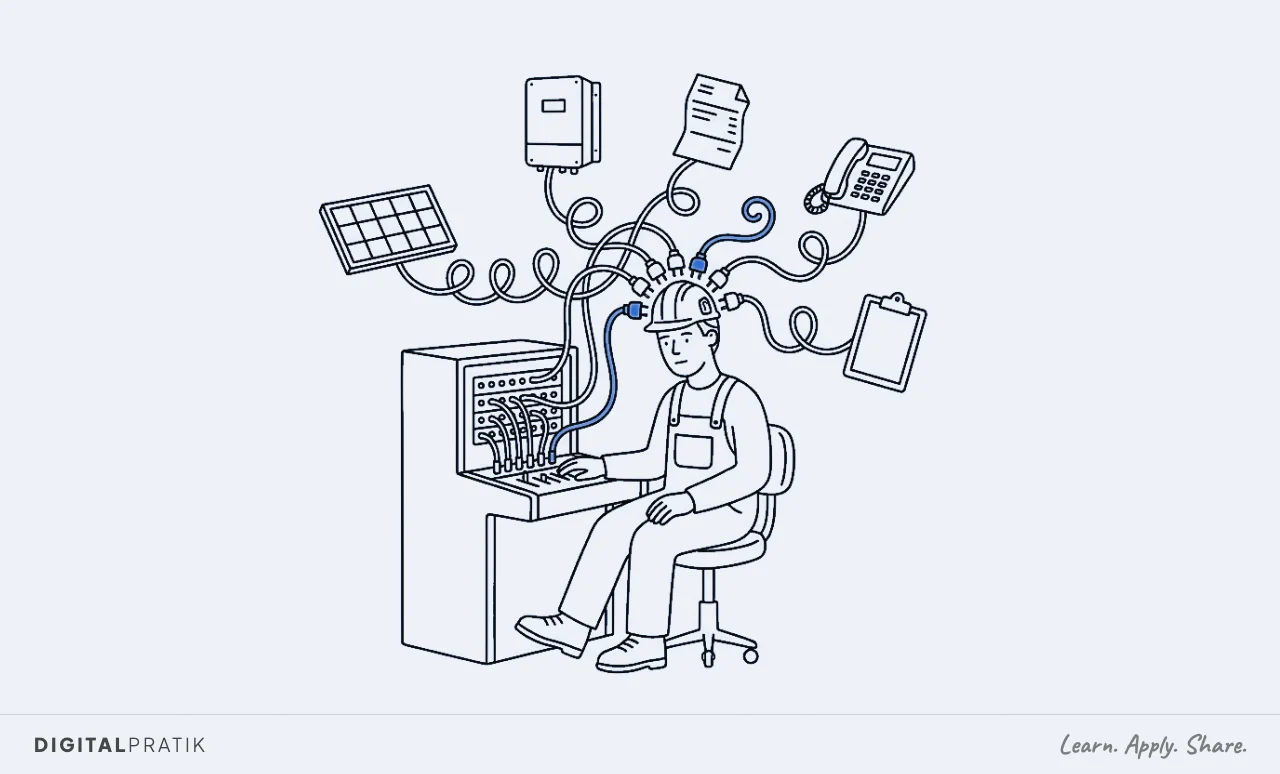
The instinct is to fix this by hiring another surveyor or another office hand. That works, and it also adds salary, supervision, and one more person who has to learn all the unwritten rules you were already the only keeper of.
You have not removed the bottleneck, you have given it a second head to depend on. The alternative is to write the routing down and let a system run the parts that never needed a qualified brain in the first place.
That is what the next nine steps do.
For a solar installer, the customer experience is the marketing
One belief before the framework, because it decides how you read the rest of it. In an installation business, the customer experience is the marketing.
Not the website, not the van livery. The quote that came back the same day, the survey booked without three phone calls, the install that ran to the day you promised, the aftercare check nobody had to be nagged into.
That is what gets a firm recommended to a neighbour, and it is produced almost entirely by the nine jobs we are about to automate.
This is why it belongs on a growth marketing site rather than in an IT catalogue. A quote that took a week to send is not an admin delay, it is a deposit a faster rival just took.
A finished install that never got invoiced is not a bookkeeping oversight, it is money you earned and then left on the roof. When the operating system is one tired owner, the customer experience frays in exactly the places a homeowner notices and a competitor asks about.
Which brings up the trap most growing installers fall into. They try to grow by chasing more enquiries and running more ads, into a firm whose delivery still runs through the owner.
That does not produce profit. It produces slower quotes, jobs that stall, and installs that slip.
This is the capacity problem, and it is one of exactly three things almost every stuck firm is stuck on. The other two are getting the right enquiries in and converting them, and I have written the full diagnostic in the 3A Machine.
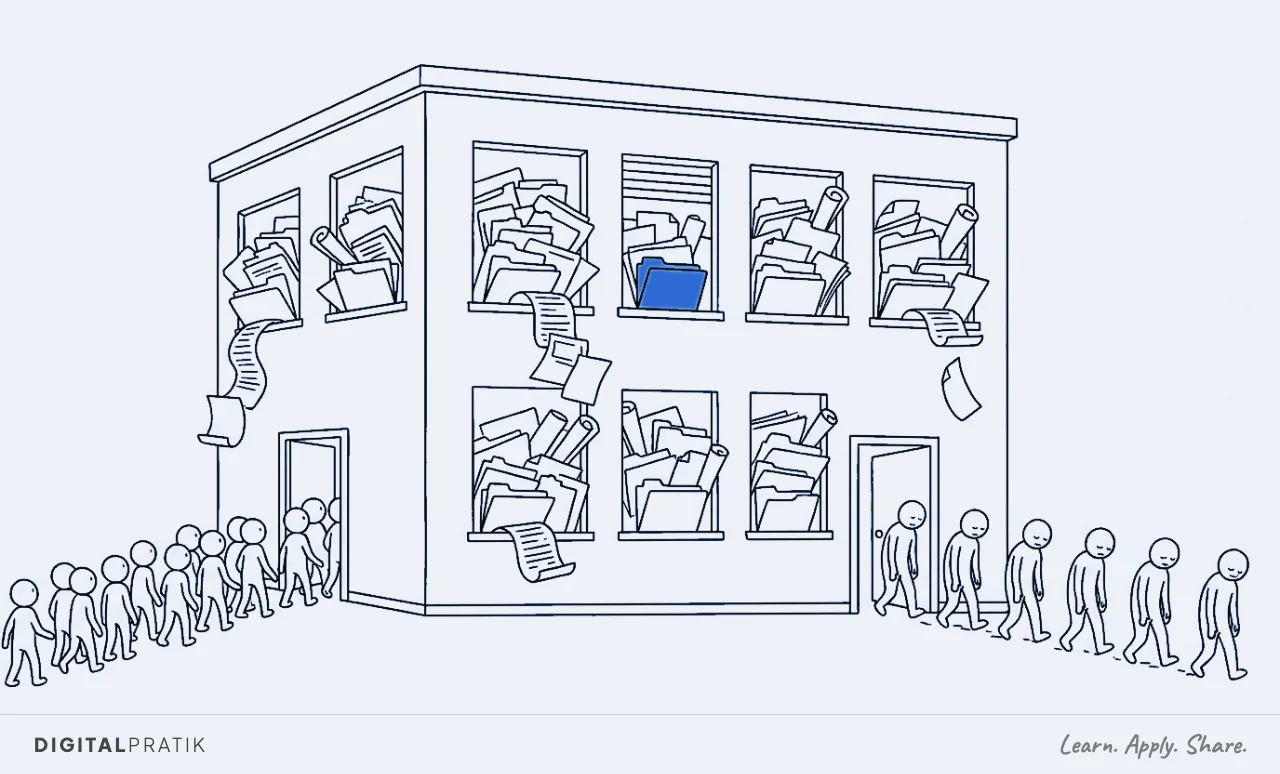
So the goal of deploying agentic AI in a solar firm is not "use AI to sell panels". It is to build the capacity that lets you grow without the quality falling over.
Get the nine steps running and the same crew and the same office hold two or three times the job volume without a single install going live before its checks pass. Fix capacity first, then go and win the work.
The nine steps, in three phases
Here is the whole map on one page. Your firm already runs all nine of these jobs today, whether or not anyone has ever named them.
The framework does not add work. It names the jobs, then decides one at a time whether a person does each one or a system does it.
| Step | Phase | The job it does |
|---|---|---|
| 1. Diagnose | Before build | Quantify what is bleeding: jobs stalled before compliance, finished installs never invoiced, hours lost chasing DNO and paperwork, enquiries lost to a slow quote |
| 2. Shadow | Before build | Follow one real job from enquiry to commissioning and excavate the unwritten rules |
| 3. SOP | Before build | Turn the recording into a written procedure, including the MCS, DNO and building control gate as a hard checklist |
| 4. Baseline | Before build | Agree the current numbers, in writing, before you change anything |
| 5. Command center | Build | One screen: the job radar, the compliance gate clocks, the job-pack wall, the completed-but-not-invoiced pile |
| 6. Procedure as data | Build | The firm's mind: every rule, standard, checklist and past answer, searchable |
| 7. The site controller | Build | Quoting from a bill and filing on time, working the procedure under four safety rules and the compliance gate |
| 8. Handover | Removal | The crew approves instead of performing: briefs, drafts, activity, blocker alerts |
| 9. Removal | Removal | The owner steps out of the routing. The weekly proof shows the system earning its keep |
Notice the shape. Four steps happen before anybody builds anything, and skipping them is the single most common reason a firm's "let us try some AI" project quietly dies.
People buy the clever part first, point it at nothing in particular, and end up with a fast tool that does not know how the firm actually runs a job. The order below is designed to stop that.
Step 1. Diagnose: find what is actually bleeding
You cannot fix what you have not counted, and most installers have never counted this. So the first step is a leak audit, and its only job is to put a number on the money already walking out of the firm.
Not a survey of how everyone feels. A count of losses.
In a solar business the leaks are always in the same few places. Enquiries that went cold because the quote took days to come back, and in this trade the firm that replies first usually takes the deposit.
Jobs that sat blocked for weeks because a DNO application went in late or a survey document was missing, holding up the whole schedule behind them. Finished installs that were commissioned, signed off and handed over, and then never invoiced, which is almost always a bigger pile than the owner guesses because raising the final bill is the boring job at the end that nobody owns.
And the hours the office burns every week rekeying an electricity bill into a quote, chasing customers for a wayleave or a roof photo, and re-explaining to a homeowner where their job has got to.
Add it up honestly and the total is almost always bigger than expected, and concentrated in two or three places rather than spread evenly. That concentration is the gift.
It tells you exactly where to point the build first, and it becomes the before number you use, at the very end, to prove the system paid for itself.
Step 2. Shadow: follow one real job from enquiry to commissioning
Now you watch. Pick one live job, a rooftop system, a battery retrofit, a ground mount, and follow it end to end, writing down every single thing that happens to it and every decision anybody makes.
From the first enquiry and the electricity bill, through the survey, the quote, the deposit, the DNO application, the install, the certification and the handover. Not the tidy version in a manual nobody opens.
The real one.
This is where you discover the firm does not run on the written process. It runs on a hundred unwritten rules that live in your surveyor's head and your lead installer's head and, more than anywhere else, in the group chat and the email threads.
Which roofs you will not quote without a physical survey. How you size a system from an annual usage figure.
When a job needs a G99 application and when a G98 notification is enough. The scaffold lead time you always add.
The customer you never book in until the deposit clears. None of it is written down, all of it is load-bearing.
The excavation is the real work of this step. You read back through the threads and pull out the rules the firm actually operates on, the ones that were never a decision, just a habit that turned out to be right.
That messy, lived-in reality is what you are about to encode. Skip it and you will automate the fantasy version of the firm, ship it, and watch the crew quietly go back to doing it their own way because the system does not know what they know.
And be honest about the fragility this surfaces: in most firms the real operating manual is one long-serving person's memory, and it walks out of the door the day they leave.
Step 3. SOP: write the unwritten procedure down
Everything you excavated now becomes one written procedure. Plain language, step by step, in the order it really happens, with every rule and every exception stated.
This is the least glamorous step in the framework and it is the one that makes an agentic system possible, because a site controller can only work a procedure that has actually been written.
And this is where the crown jewel of a solar build gets written down, because for an installer one part of the procedure is not like the others. A job cannot go live until it has passed its compliance checks, and there are three that matter most.
The MCS certification, so the system is registered and the customer can claim what they are owed. The DNO approval, so the grid operator has actually agreed to the connection under G98 or G99.
And the building control notification, so the work is signed off as safe and lawful. Written as a procedure, that becomes a hard gate: the job does not advance to commissioning until MCS, DNO and building control have all passed, full stop.
No tired owner waving it through on a Friday because the crew is already booked for Monday.
The same discipline applies everywhere else. A survey becomes a checklist of what must be captured before a quote can be priced.
Onboarding a customer becomes a sequence rather than a thing your best surveyor simply "knows". A handover becomes a defined pack, not a folder somebody meant to tidy.
Each becomes a written sequence a machine can enforce perfectly, every time.
Write it for a smart new hire on their first day, not for a machine. If a person could follow it without asking a single question, a system can run it.
If it still needs somebody to "just know", the procedure is not finished, and you are not ready to build. One line matters more than any other in this step: the gate is not advice, it is a wall.
Step 4. Baseline: agree the numbers before you touch anything
The last step before the build, and it is thirty minutes that saves you a year of arguments. Write down the current numbers and get the owner and the office to agree them.
How long a quote takes to go out from the moment the enquiry lands today. What share of jobs actually clear all three compliance checks before the crew is booked, rather than scrambling for a certificate on the day.
How much finished work is sitting commissioned but unbilled right now. How fast the first reply to a new enquiry goes out.
Real numbers, honestly rounded, on the record.
You do this for one reason. In three months, when the system is running, memory rewrites history.
People forget how bad it was, decide it was "always basically fine", and start to wonder what they are paying for. The baseline is the receipt.
It is what lets the weekly proof report at the end say "a quote went from three days to under an hour" and have that land as a fact everybody agreed up front, rather than a vendor's claim.
It is also the moment to decide what "better" means for this firm, so the build aims at a number and not a vibe. A firm bleeding on unbilled finished jobs is not chasing the same win as one losing deposits to slow quotes.
Name the number now. It is what everything you build next is pointed at.
Step 5. The command center: the whole firm on one screen
Now you build, and the first thing you build is the place the owner looks. One screen that shows the whole firm at a glance, in the order that costs money, so nobody reconstructs the state of the business from a job-management app, a spreadsheet, an inbox and the group chat every morning.
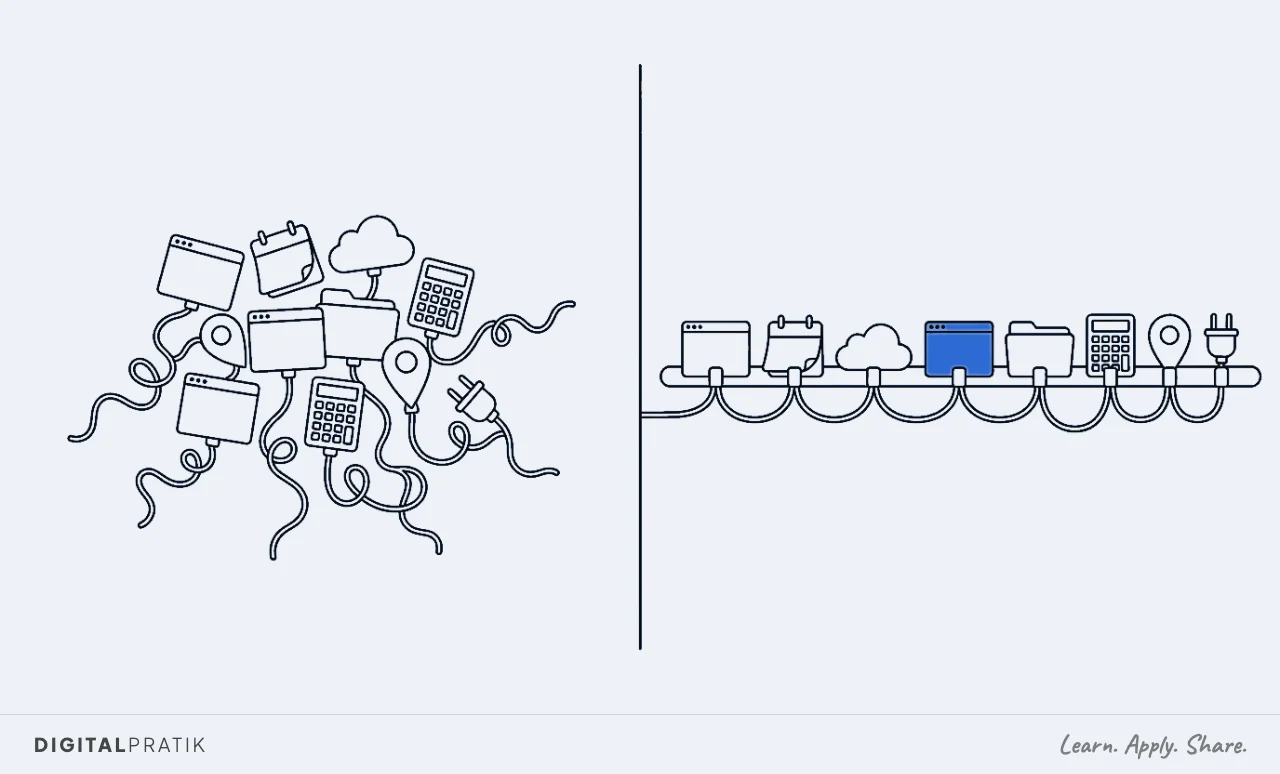
Build it on one spine, not twelve tools. This matters more than it sounds.
Every job in the audit is tempting to solve with its own separate app, and a year later you have a dozen subscriptions that do not talk to each other and an owner who is now the integration layer between them. Build the whole thing on one foundation, one place the data and the context live, and the next piece is nearly free because everything it needs already exists.
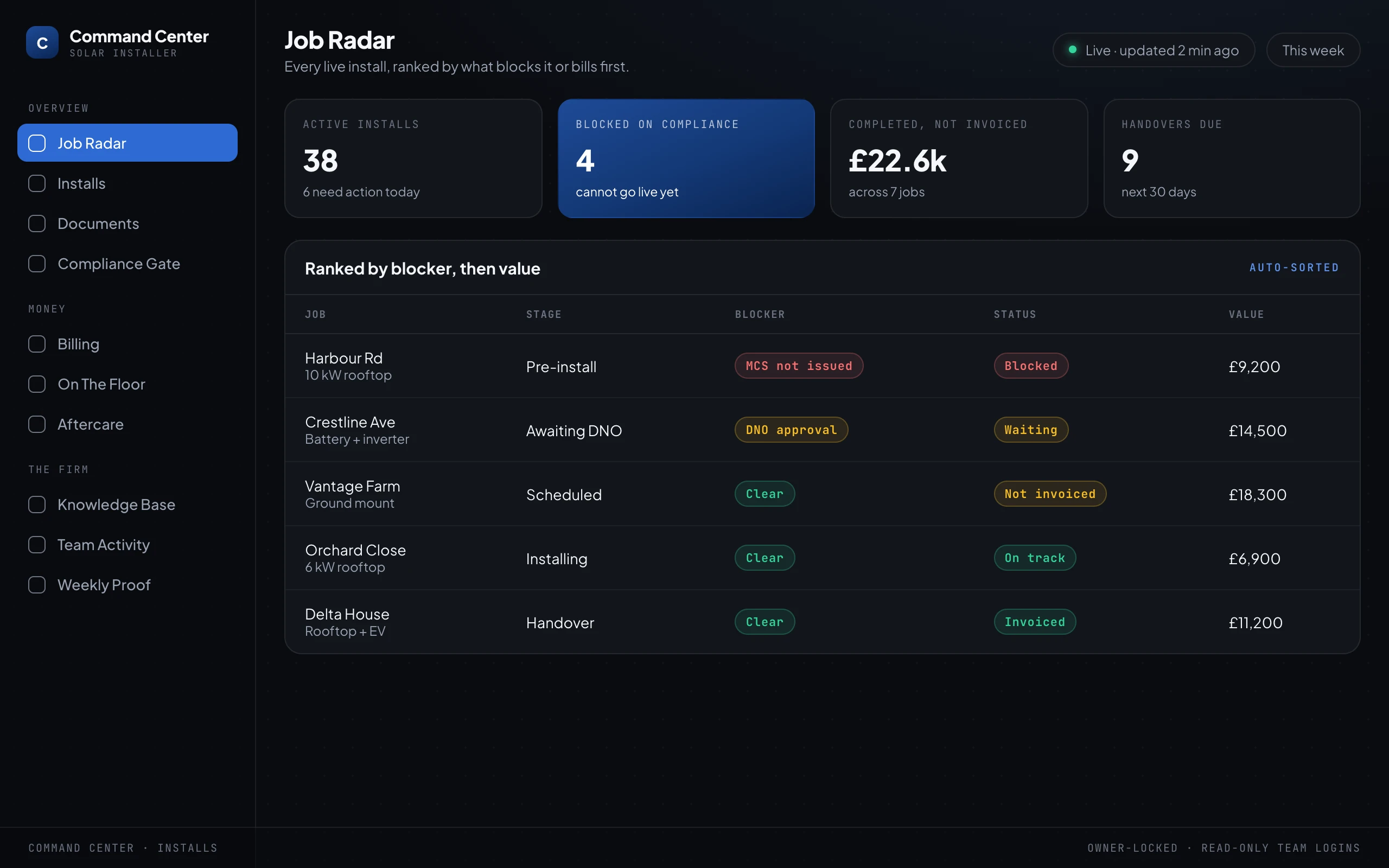
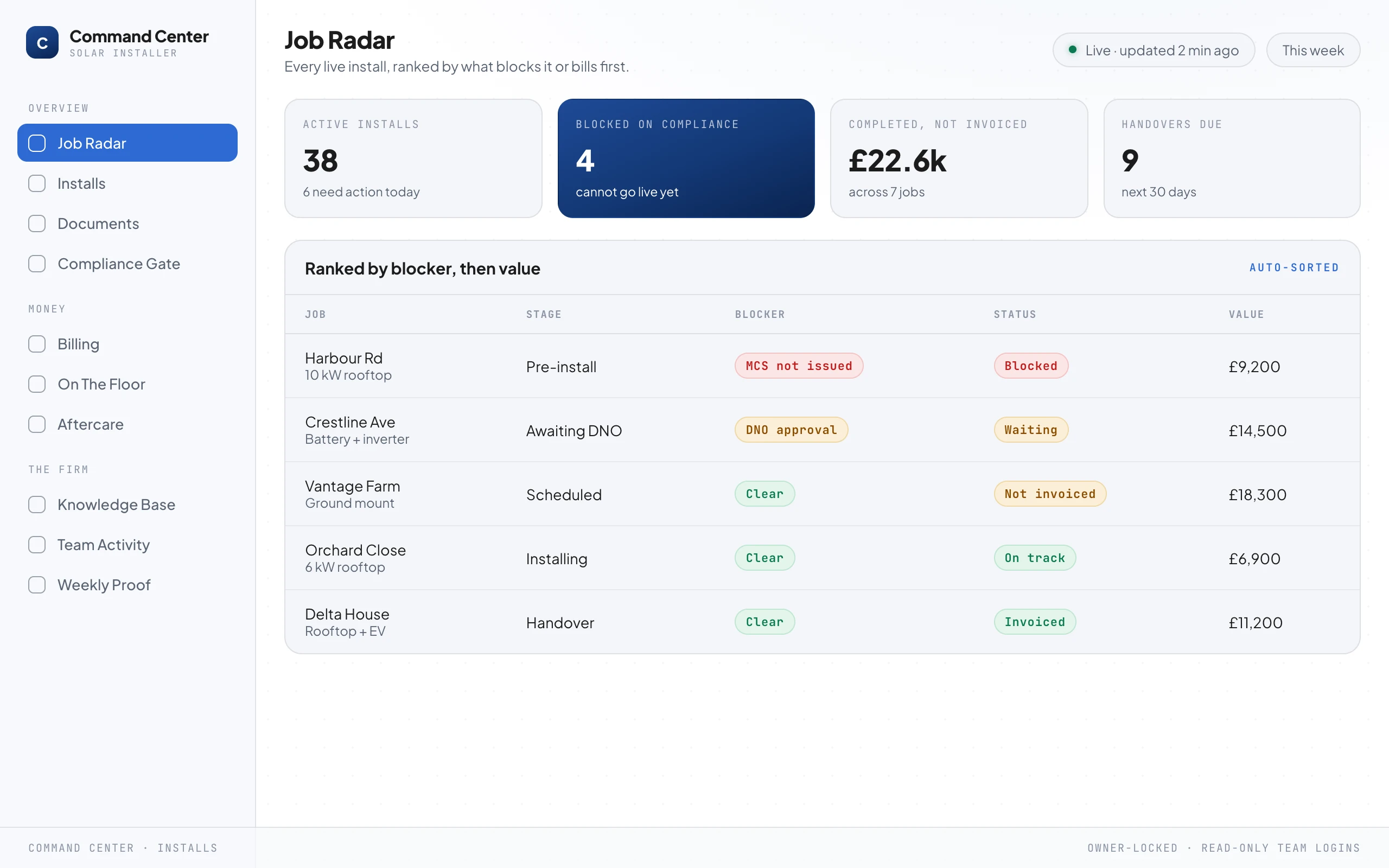
The centre of the screen is a job radar: every live install, ranked not by date but by what blocks it or bills first. The job sitting blocked on a missing MCS certificate sits at the top, in red, whether or not anybody asked.
The job waiting on the DNO sits just below it in amber, because the grid operator, not the crew, controls when it can move. Around them, the numbers an owner actually needs, the jobs that need action today, how many are blocked on compliance, how much finished work is completed but not invoiced, how many handovers fall this month.
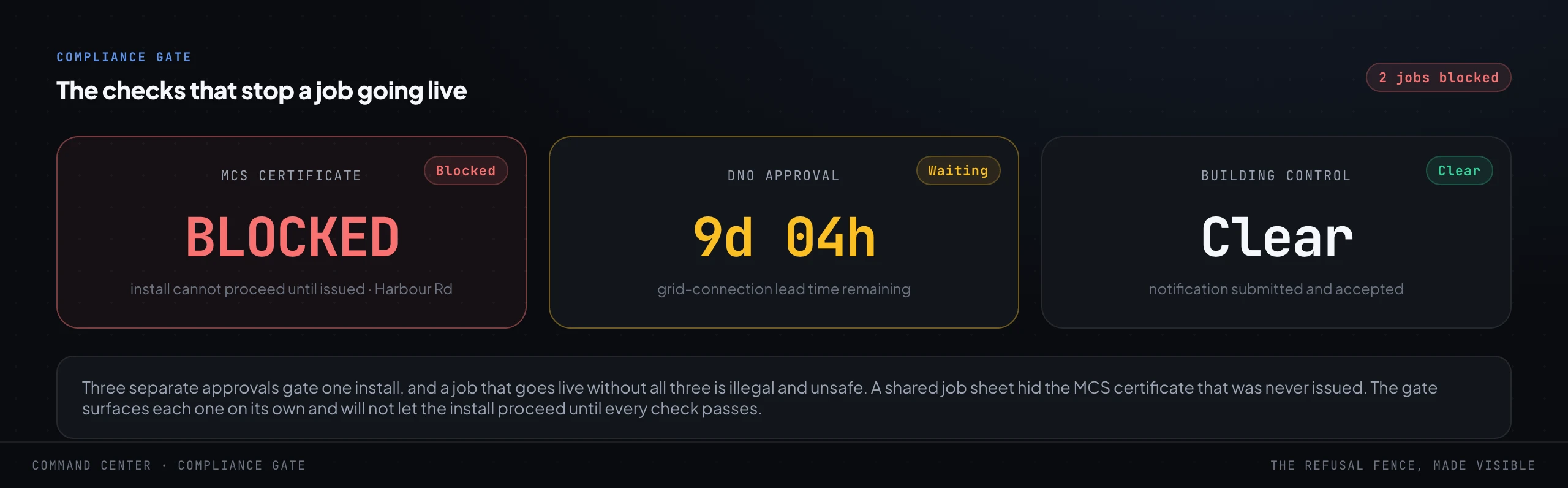
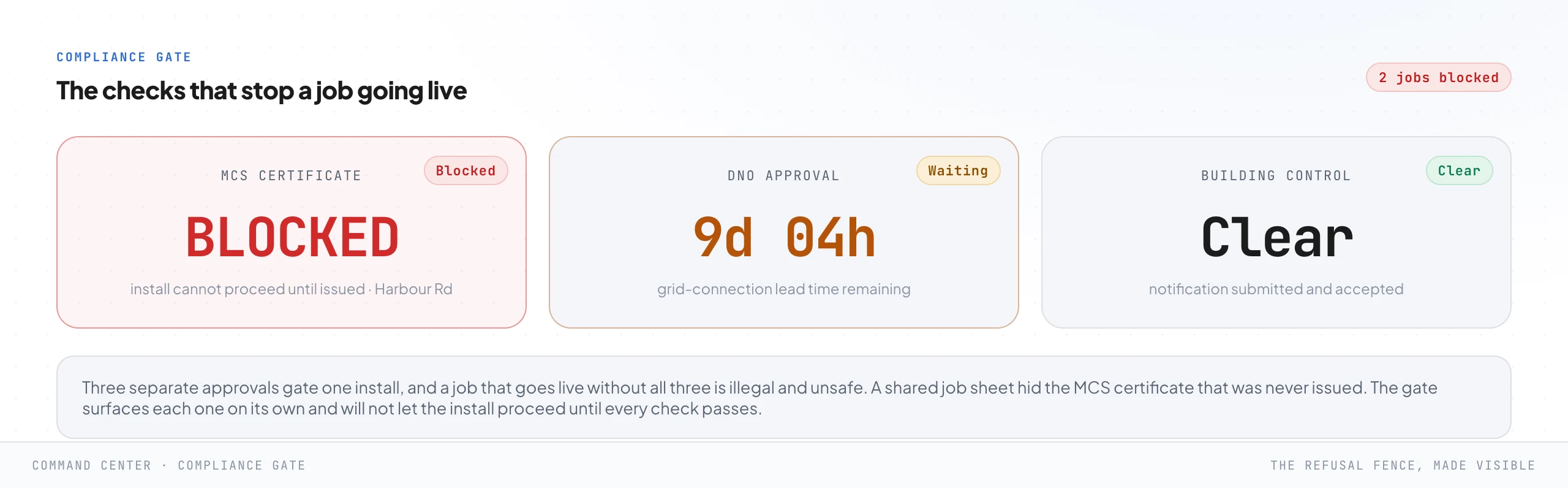
Then the compliance gate, and this is the piece that makes an installer sit up, because it is the crown jewel of the whole build. A job does not have one approval, it has three that all have to land before it can go live, and each is controlled by a different body on a different clock.
The command center pulls them apart and shows each on its own. The MCS certificate, the DNO approval, the building control notification, three separate states, and the job cannot be marked ready to commission until all three read clear.
A single job sheet used to flatten this into one comforting tick that hid the one certificate that never came. The gate refuses to let that happen.
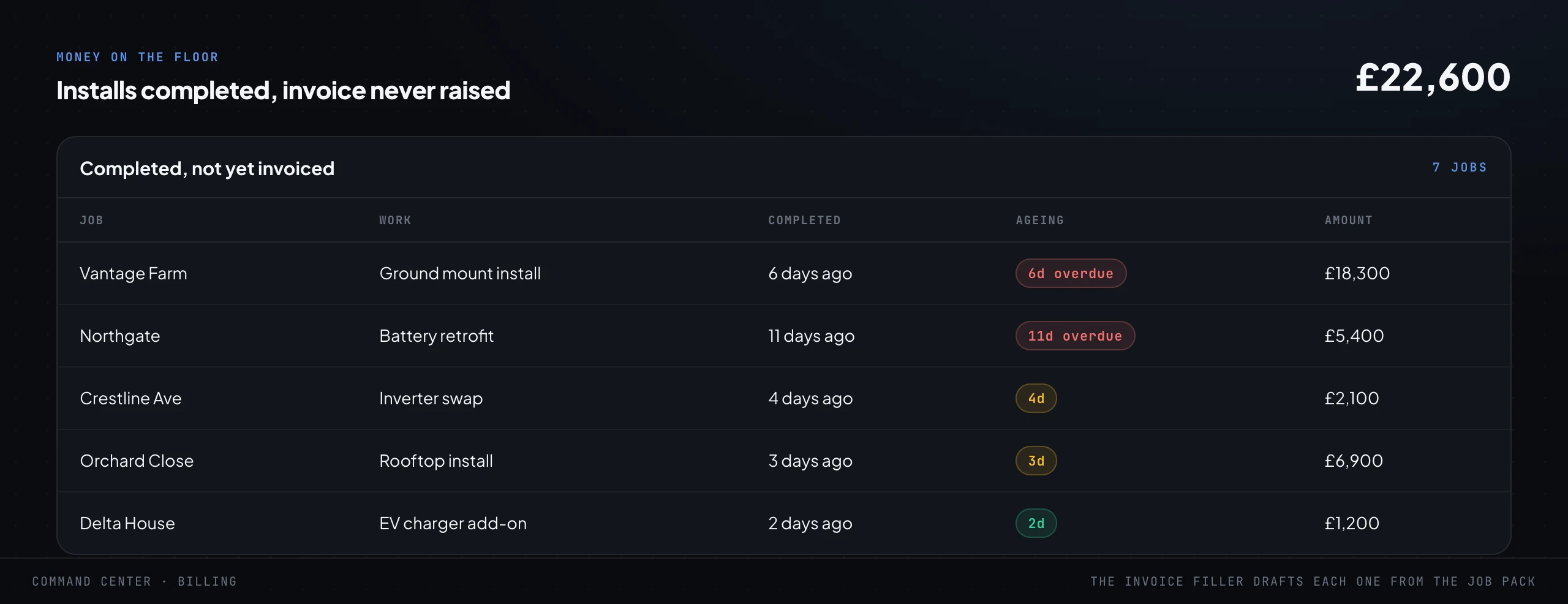
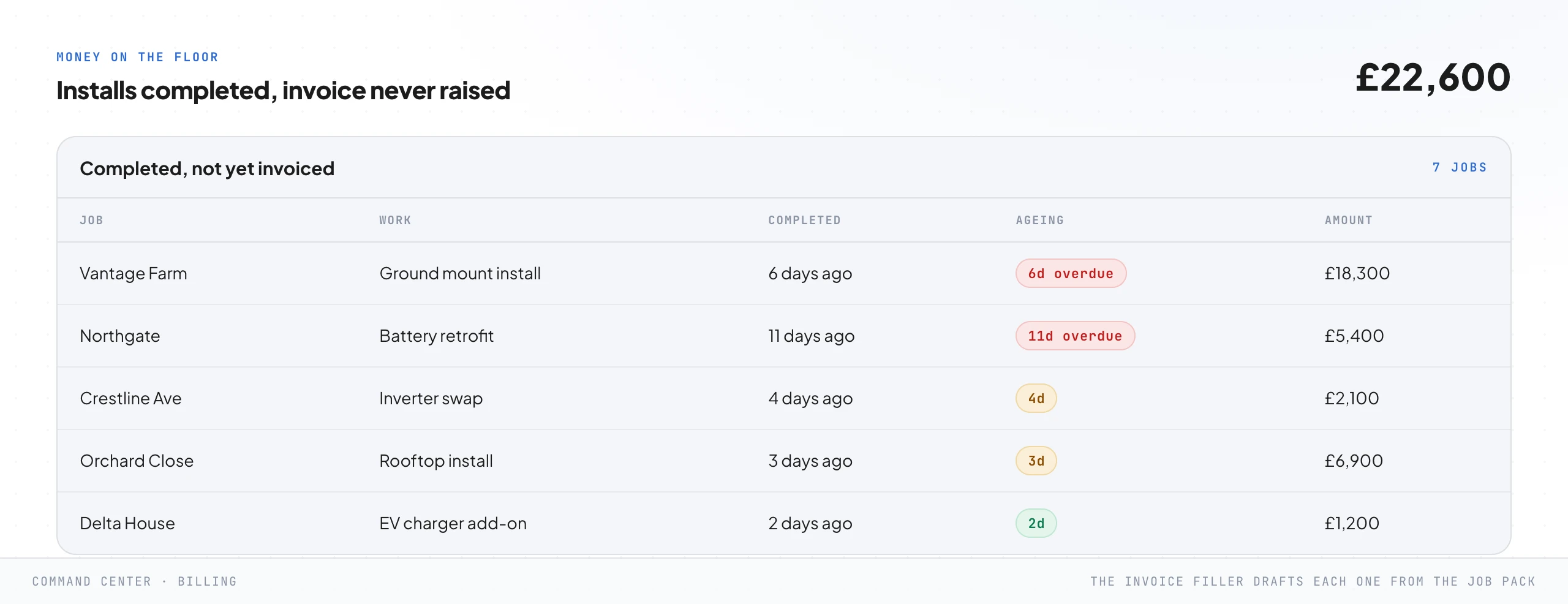
Beside the gate, the money on the floor: every install completed, commissioned, handed over, and never invoiced. In most firms this is a genuinely uncomfortable number the first time it appears on a screen, because the work was already paid for in scaffolding, panels, labour and a full day on a roof, and simply never got billed.
It was not strategy. It was that raising the final invoice was a small annoying job at the end that nobody owned, which is a fair description of most of what leaks in an installation business.
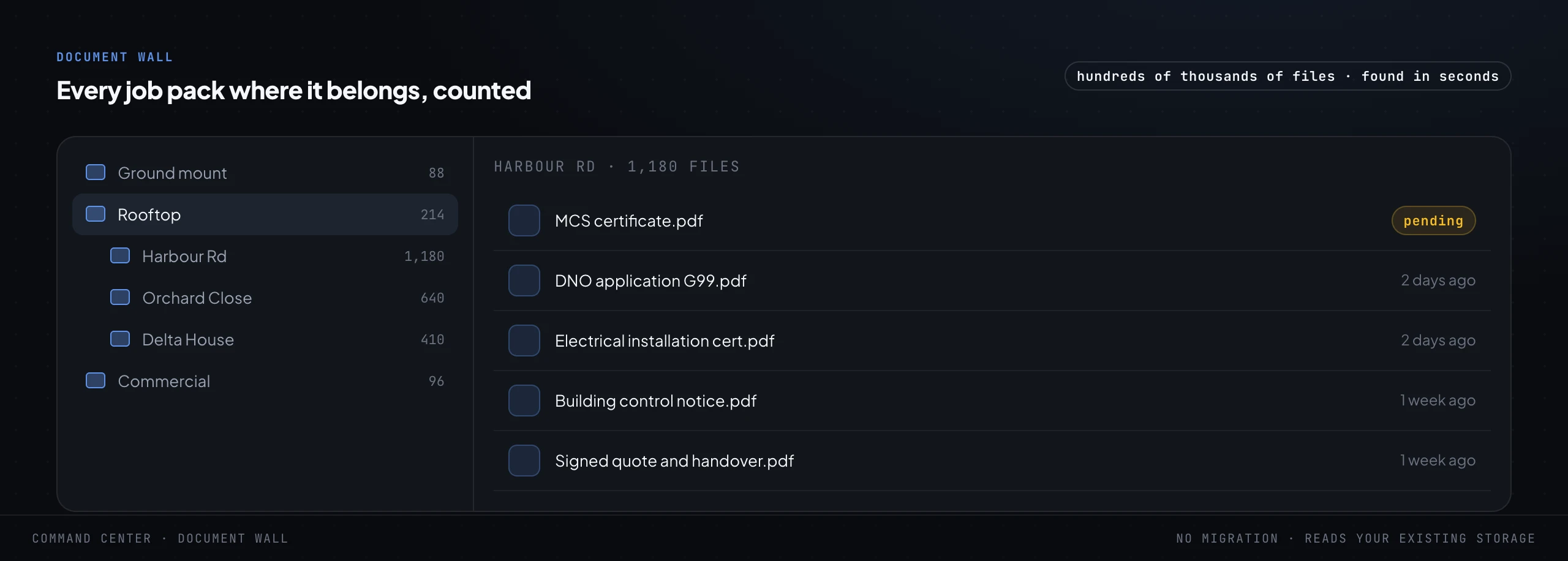
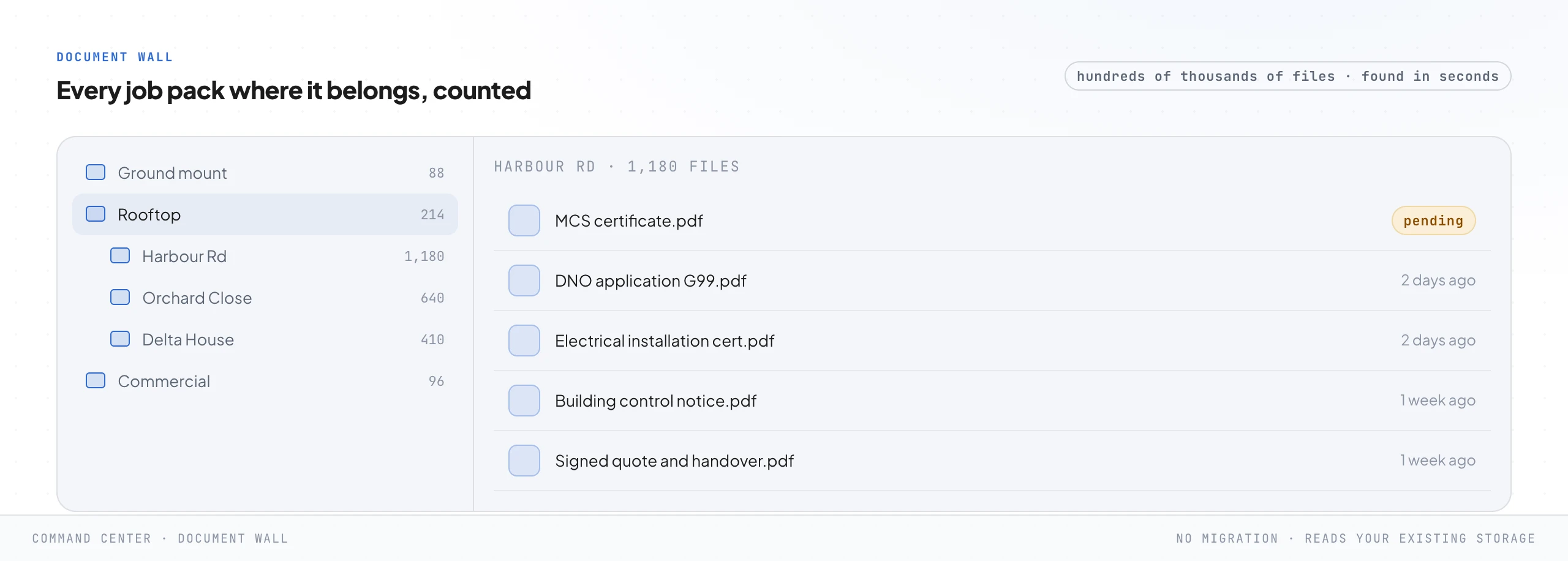
And the job-pack wall. An established installer is sitting on an enormous pile of documents, hundreds of thousands of files across folders nobody has fully mapped in years.
Certificates, applications, surveys, signed quotes, handover packs, all of it scattered. The command center reads that existing storage where it already lives, with no migration and no "please move everything into our new system", and makes it navigable and countable, so any document is found in seconds instead of a frightened hunt while a homeowner waits on the phone for their MCS certificate number.
One design choice worth naming, because customers always ask. The command center is owner-locked, and the crew gets read-only logins scoped to what they need.
The owner sees the money and the whole board. An installer sees the jobs assigned to them and what is blocking each one.
Nobody can quietly change a compliance state they should only be reading, and the owner never loses the single honest view of the firm the whole build exists to give them.
Three things run underneath all of it, quietly. The whole system is backed up on a schedule, so a bad day is never a lost day.
It is locked down so the data only ever answers to the people you named. And a heartbeat watches the system itself: if a job that should run every morning goes quiet, you hear about it before a client does.
None of this is glamorous and all of it is why you can actually trust the thing to run without you standing over it.
Reading the map and walking it are different jobs. If you run an installation business turning over £50k a month or more and you are still the operating system, this is what a working session looks like.
Step 6. The procedure as data: the firm's mind
The procedure you wrote in step 3 is a document, and a document just sits there. In step 6 you turn it into data the system can reason over: every rule, every standard, every checklist, every piece of grid-connection guidance, and every good answer the firm has ever given, connected by meaning rather than filed in folders.
This is the firm's mind, and it is what makes the site controller in the next step sound like your firm instead of a generic model.
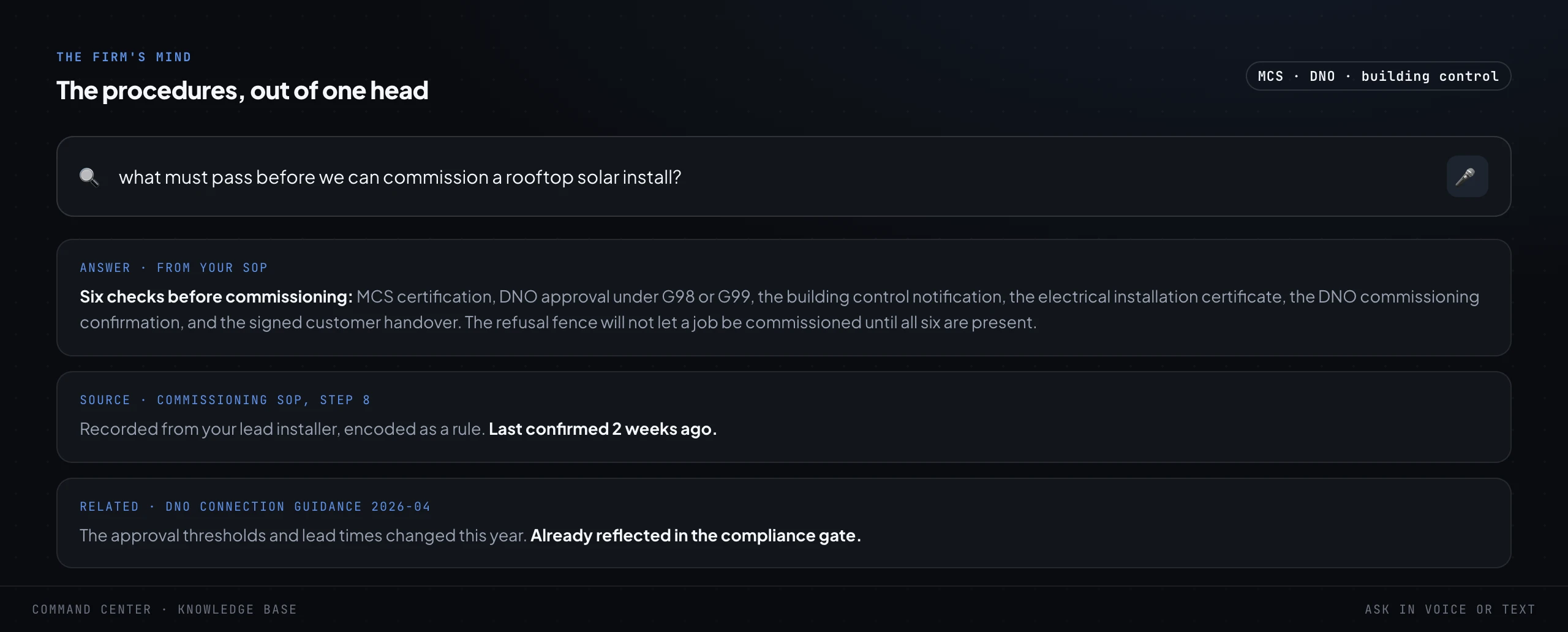
In practice it means anybody can ask a plain question and get the firm's own answer, not the internet's. What has to pass before we can commission a rooftop install.
When does a job need a G99 application rather than a G98 notification. What is in our standard handover pack.
The answer comes back grounded in the firm's own written procedure, with the source it came from, so it is checkable rather than a confident guess.
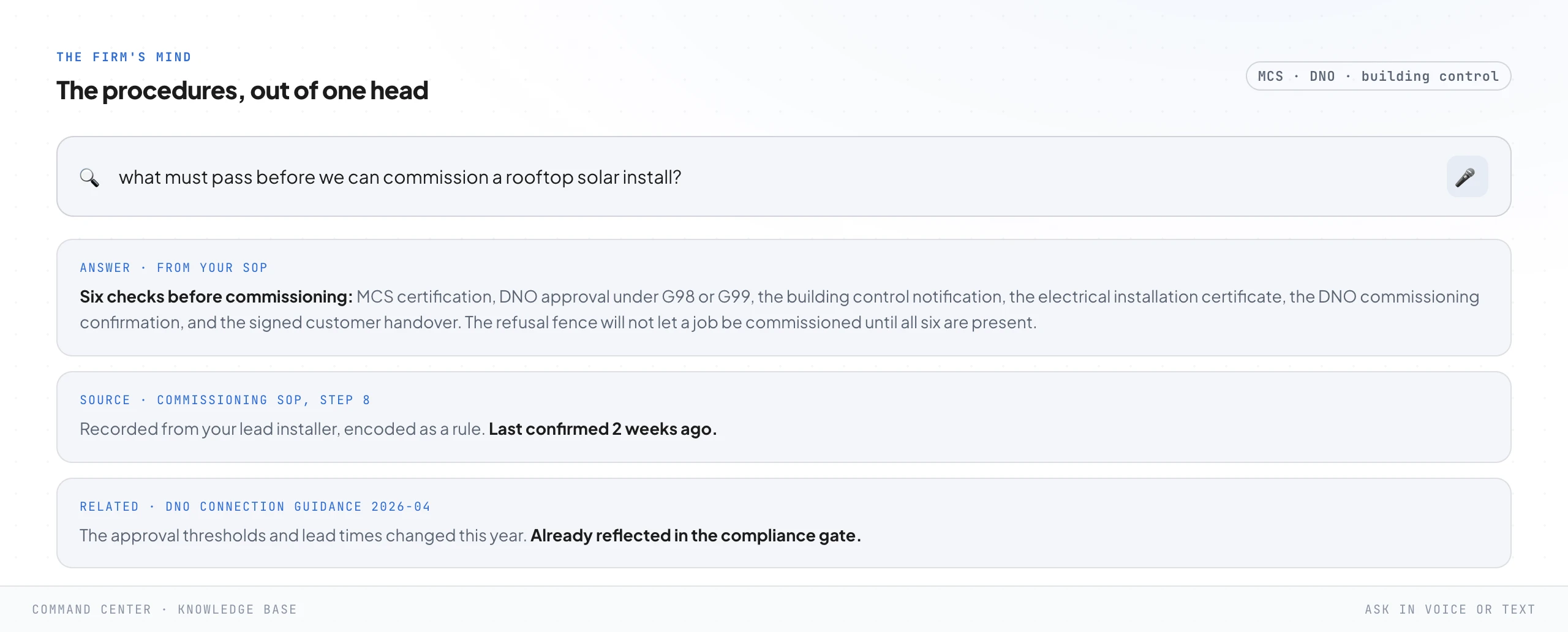
The reason this matters more than it looks is drift. A general model, asked the same compliance question twice, will happily give two confident and slightly different answers, and in a trade where a wrong answer means an unsafe or uncertifiable job, that is not a quirk, it is a liability.
Grounding every answer in the firm's own written procedure kills it. The system is reading your rules and quoting them with the source, and when a standard changes you change it in one place and every answer changes with it.
It is also where the compliance gate becomes enforceable rather than advisory, because the site controller in the next step reads its gates from exactly here.
Step 7. The site controller: quoting and filing that shows up on time
Now the part people picture when they hear "AI". An employee, not a chatbot, and the distinction is the whole thing.
A chatbot waits to be asked. An employee wakes on a timer, reads the live job board, does its round, files the work, and flags what needs a human, whether or not anybody prompted it.
I have written the longer version in AI employees, not chatbots.
In a solar firm it is a small crew of them, each with one job, all reading from the firm's mind. And the one owners fall in love with first is the bill-to-quote agent.
A homeowner photographs their electricity bill and sends it in. The agent reads it, pulls the annual usage, and comes back with an indicative system size, a first-pass quote and a savings estimate, drafted and waiting for a person to approve.
The enquiry that used to sit for three days while somebody found a gap to price it gets a considered first answer in minutes, which in this trade is very often the difference between your deposit and a rival's.
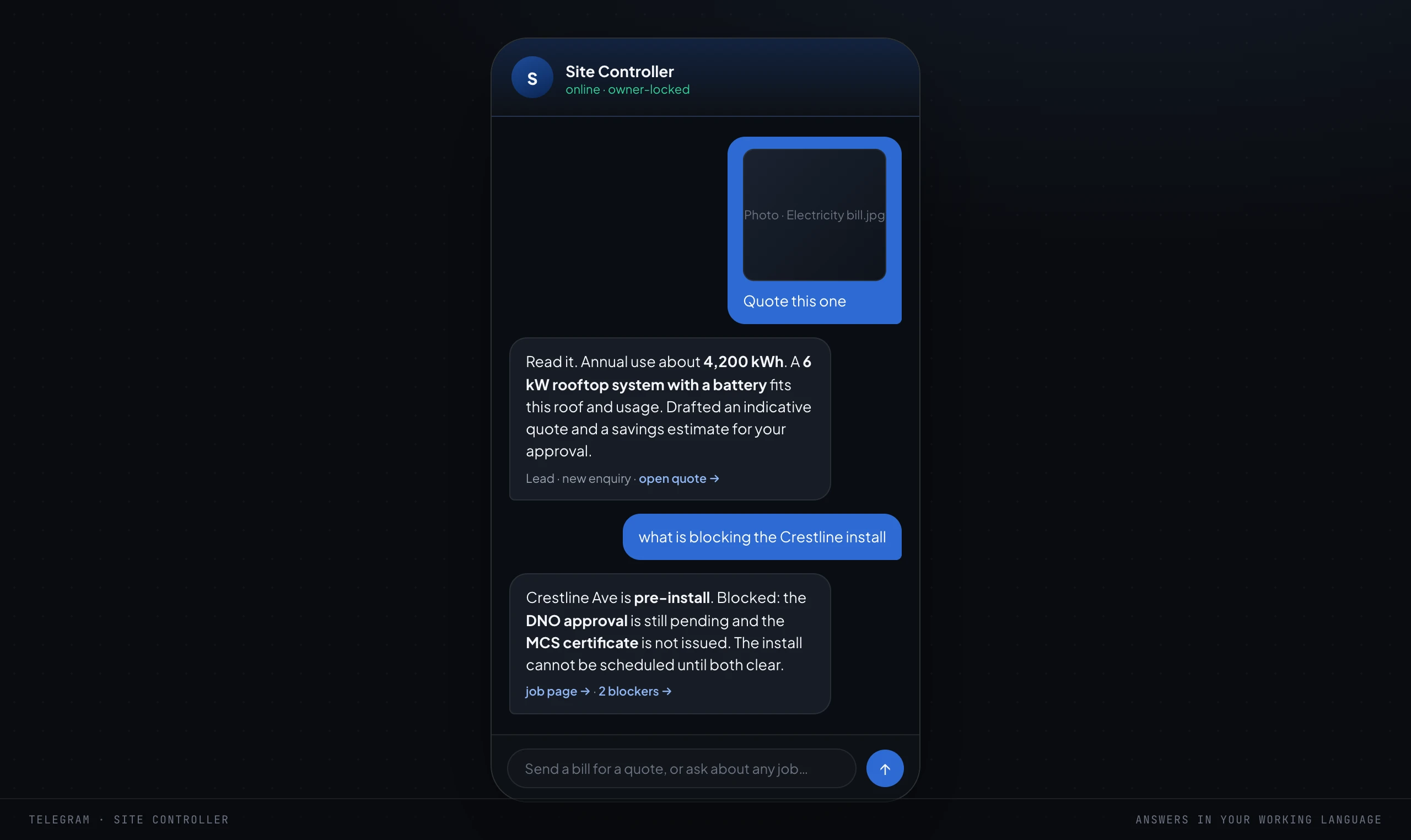
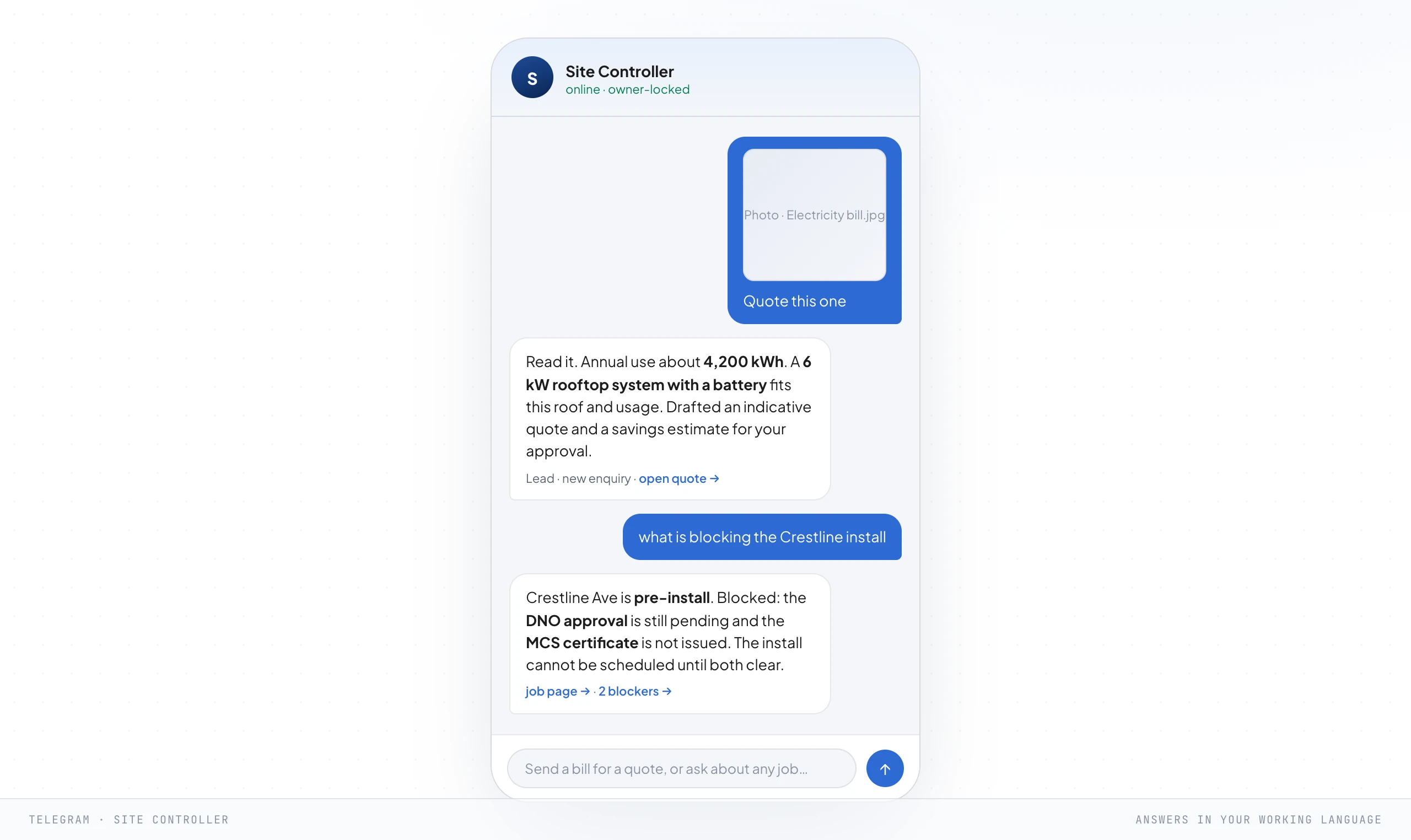
Alongside the quoting agent, the rest of the crew. A document controller that reads a photographed certificate, survey photo or signed quote, understands it, files it to the right job pack and logs any expiry to the clock.
The refusal fence, which is the compliance gate given teeth: it will not let a job move to commissioning until MCS, DNO and building control all read clear, and it says exactly which one is missing when it refuses. An invoice filler that drafts the final bill for a completed install straight from the job pack.
And a talking agent that answers a customer's "where has my job got to" in their own words, without pulling a surveyor off a roof.
There is a quieter agent in this crew that owners never ask for and always end up valuing most: a critic. Before any piece of work reaches a human, a second agent grades it against the procedure.
Does the quote match the survey, is the system sized sensibly for the usage, is every compliance item accounted for. Anything that fails goes back to be redone before you ever see it.
This is the line between AI you can run and AI you can trust in a trade where a mistake ends up on a roof.
An employee that can act is useful and it is also dangerous, so this step ships with four safety rules and they are not optional. They are the reason you can hand a system this much and sleep.
- It refuses out-of-procedure work. If a job or a request does not match the written procedure, the site controller declines and escalates rather than improvising. Above all, it will not mark a job ready to commission until MCS, DNO and building control all pass. The refusal fence is a feature, not a failure.
- Every file operation stays inside set boundaries, and deletes go to a recycle bin. It cannot reach outside the job packs and folders it was given, and nothing it removes is ever gone. A certificate filed to the wrong job is always recoverable.
- Every customer-facing message waits for a human yes. It drafts the quote, the update, the reminder, the invoice, then stops. A person reads it and presses send. Anything that touches a customer, their money or the firm's name gets a human on it.
- Ambiguous facts come back empty, never guessed. If it is not sure of a roof pitch, a usage figure or whether an approval has actually landed, it says so and asks. A blank is safe. A confident wrong number on a quote, or a job marked clear when a certificate is still pending, is how a system does real damage.
Two things make that crew safe to hand real work to. First, each agent is given a narrow, controlled connection to the business's own tools, its files, its records, its calendar, and nothing beyond them.
It works inside your systems, so it answers from your firm rather than the open internet, and it cannot wander off to touch anything you did not hand it. Second, every action it takes comes back as a receipt: a short note in the chat that says what it just did, so nobody is ever guessing what the system touched.
All of it runs on Claude, the model we build everything on.
Step 8. Hand it to the crew
The build is running. Now it stops being the owner's private tool and becomes how the crew works, and the shift is subtle but total: people move from performing the work to approving it.
The system does the first pass of everything, the quote, the update, the invoice, and a person says yes, changes a figure, or sends it back. Same crew, far more jobs handled, and your qualified people are left doing the surveying, the installing and the sign-off that were always the actual job.
That handover is made of a few specific things. A quote drafter that turns a new enquiry into a first-pass price a person just approves.
An activity wall so the owner can see what the system and the crew did without asking. A blocker watcher that notices when a job has sat waiting on the DNO for a week, or a certificate is overdue.
And the piece everyone feels first: the morning brief.
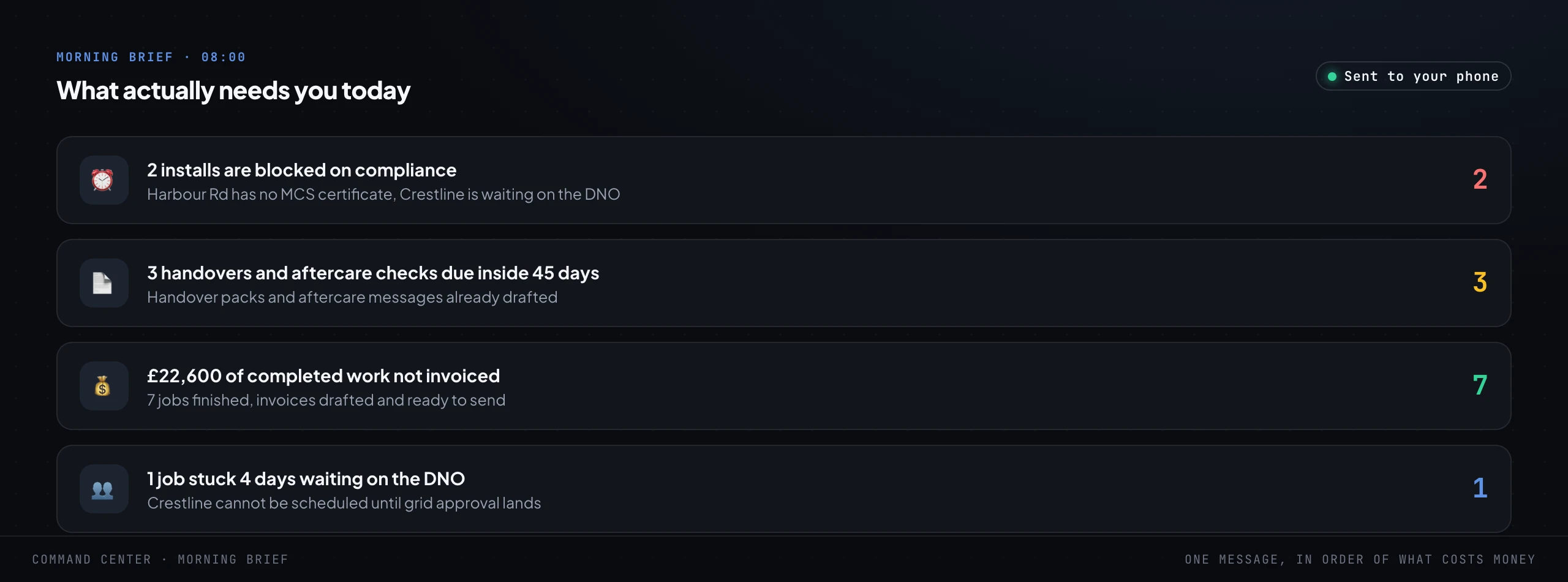
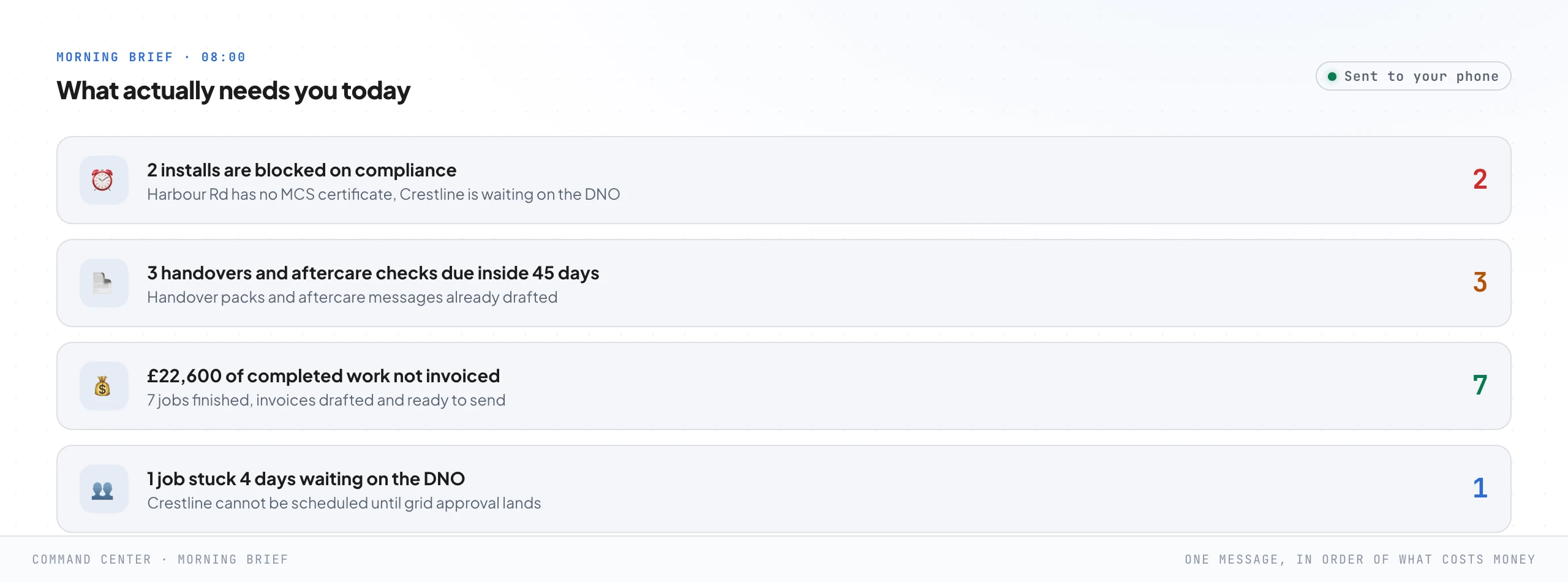
At eight in the morning, before anyone opens anything, one message lands in order of what costs money: here are the two installs blocked on compliance and exactly which check each is waiting on, here are the handovers and aftercare visits due this month with the packs already drafted, here is the completed work waiting to be invoiced, here is the job stuck because the DNO has not come back. The crew walks in already knowing the day instead of spending the first hour discovering it.
A word on the human side, because it decides whether any of this sticks. The word removal frightens a crew, and if they think it means removing them, they will quietly starve the system of the knowledge it needs.
It does not mean that. It means removing the rekeying, the chasing, the frightened certificate hunts, and leaving people with the surveying, the installing and the customer relationships that were always the skilled work.
Say it out loud, early and often. A crew that believes the system is on their side will feed it.
A crew that fears it will fight it, and win.
Step 9. Removal is the whole point
Here is the step everyone gets wrong, and it is the reason the framework exists. Step 9 is not training.
It is removal. The goal was never to teach the owner to use a clever new tool.
It was to take the operating-system job out of the owner's head, so the firm stops running at the speed of one person's attention.
You know you have reached it by a specific test: the owner can take a genuine week off and nothing leaks. Enquiries still get a same-day indicative quote.
Jobs still move through survey, DNO and install in the right order. No job goes live until its three checks pass, because the gate does not care whether anyone is watching.
Finished work still gets invoiced. Customers still get answered in their own words, the same day.
Nothing waits for one person to come back and look, because that person is no longer the thing the routing runs through. They approve the exceptions from their phone, or they do not, and it holds either way.
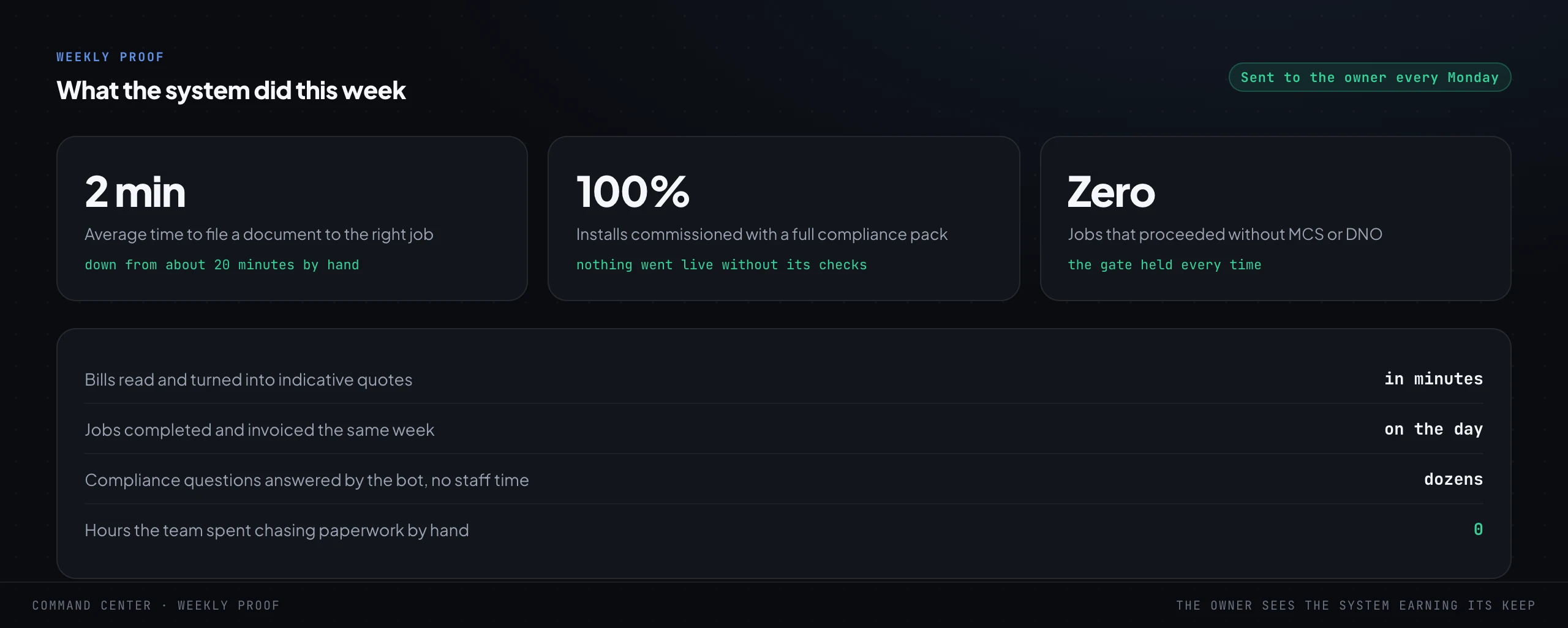
And this is where the baseline earns its keep. Every Monday a proof report goes to the owner and says, in the numbers they agreed at the start, what the system did this week.
Bills turned into quotes in minutes instead of days. Every install commissioned with a full compliance pack behind it.
Zero jobs that went live before MCS or DNO cleared, because the gate held every time nobody was looking. It is not a dashboard somebody has to go and check.
It is the system reporting to the owner, unprompted, on whether it is still earning its keep.
And then the question that is really the point: what does the owner do with the attention they just got back. In every firm the honest answer is the same, and it is why this belongs on a growth marketing site.
They go and do the work only the owner can do. Winning the right jobs, the commercial contracts that carry the real margin, the next crew, the next van.
Removal is not the end of the owner's involvement. It is the first time the owner gets to actually be the owner of the firm rather than its busiest employee.
What it costs to run
This is the question every owner asks within about ninety seconds, and the honest answer surprises people in the right direction. It is far less than they expect, and far more transparent, because the running cost is metered and shown like a utility bill rather than hidden inside a flat fee.
Which, for a firm that sells energy savings, is a fitting way to buy the thing.
For a working system on a real firm's volume, the AI usage runs on the order of a few pounds a day, and the hosting and database are a few tens of pounds a month, so the whole thing comes to roughly a hundred pounds a month to run. Your volume will differ, which is exactly why the meter is built in from day one and shown to the owner on day one.
No hidden meter, ever.
Now put that next to what it replaces, with round numbers you can redo with your own. Say the owner and the office lose two and a half hours a day to pricing quotes by hand, chasing the DNO and the customer, and rekeying bills and certificates, across twenty two working days.
That is fifty five hours a month. Value that time at even a modest fifty pounds an hour, low for skilled people, and it is over two and a half thousand pounds a month of attention, against roughly a hundred to run the system that gives most of it back.
And that ignores the two biggest wins, because neither shows up as time saved: the deposit you won because your quote landed first, and the finished install that finally got invoiced. Those show up as revenue that did not leave.
Where to start on Monday
Nobody builds all nine steps at once, and you should not try. This is a map, not a project plan, and the map is useful the moment you have it, because it tells you where you are and what the next single step is.
So do not start with the screen that impressed you most. Start with the step the audit said is bleeding worst.
If enquiries keep going cold before you can price them, the bill-to-quote agent pays for the whole build in the first month. If finished jobs keep going unbilled, the money-on-the-floor wall and the invoice filler are the fastest money in the room.
If jobs keep going live in a scramble for a certificate, or nearly do, build the compliance gate first and never lie awake about it again. The full logic for choosing the first thing is in what to automate first in a service business, and the honest way to measure whether it worked is in true ROI versus reported ROAS.
One thing at a time. Diagnose, build the one piece that hurts most, put a human gate on anything irreversible and a compliance gate on anything that has to pass, then the next piece, which will be cheaper than the first because it sits on the same spine.
That is the whole method. This same framework runs in an accounting practice, a law firm, a clinic and a construction consultancy, the labels on the screens change and the nine jobs do not, and the full walk-through of the general version is in the 9-step framework for deploying agentic AI.
The installers who end up with a real system instead of a browser full of half-used tools all started the same way: one step too small to fail, aimed at a number they had already agreed was bleeding.
Frequently asked questions
It is a sequence of nine steps in three phases. Before you build: diagnose the leaks, shadow one real job from enquiry to commissioning, write the unwritten procedure down including the MCS, DNO and building control gate, and baseline the current numbers. Build: a command center, the firm procedures turned into searchable data, and a site controller that works under safety rules. Removal: hand the work to the crew as approvals, then remove the owner from the middle of every job. The point is step nine, which is removal, not training.
Each install carries three separate approvals on the command center, the MCS certification, the DNO approval under G98 or G99, and the building control notification, shown as three states rather than one tick. A refusal fence built from the firm procedure will not let a job be marked ready to commission until all three read clear, and it names exactly which one is missing when it refuses. The certification and electrical sign-off stay with your qualified installers. The system removes the chasing and the paperwork, never the safety judgement.
A homeowner photographs their electricity bill and the site controller reads the annual usage, suggests an indicative system size, and drafts a first-pass quote with a savings estimate in minutes. It is a draft, not a sent quote. Every customer-facing message waits for a human yes, so a surveyor reviews and approves it before it goes out, and a physical survey still confirms the roof before a firm price. It removes the three-day delay that loses deposits, not the professional check.
On a real firm's volume the AI usage runs on the order of a few pounds a day, plus a few tens of pounds a month for hosting and the database, so roughly a hundred pounds a month in total. The meter is shown to the owner from day one rather than hidden in a fee. Set against fifty-plus hours a month the owner and office lose to pricing by hand, chasing the DNO and rekeying paperwork, plus the deposits won by quoting first and the finished jobs finally invoiced, the arithmetic is not close.
Your software is where the job records live. This is the layer above it that decides what happens and when, across every install at once. It reads the enquiry and drafts the quote, files the certificates, watches the MCS, DNO and building control gate on every job, chases what is missing, drafts the invoices and answers the status questions, then hands the owner only the judgement calls and the approvals. It is not a replacement for your job board. It is the operating system that stops all of that landing on one owner's desk.
Install this in your business
An article gives you the map. A working session gives you the system, built around what you actually sell and who actually buys it.