
The 9-Step Framework for Deploying Agentic AI in a Nutrition Club
 Digital PratikGrowth Marketing Consultant
 A nutrition club deploys agentic AI in nine steps across three phases.
Before you build, you diagnose what is leaking, members who stop checking in, memberships lapsing, product orders never invoiced, then shadow one member from signup to renewal, write the onboarding and follow-up procedure down, and baseline the numbers.
Then you build a command center, turn the club procedures into searchable data, and add a club assistant that works under strict safety rules.
Then you remove yourself.
Step nine is removal, not training.
Here is the part nobody says out loud to the owner of a nutrition club. Somewhere between your first regulars and a full room of members, you stopped being only the coach and became the operating system.
Every new signup who needs a plan, every member who quietly stopped coming, every "did we ever actually bill that product order", every membership sliding toward its renewal date waits on your attention. Which means the whole club runs exactly as fast as one owner can keep track of it while also weighing shakes, running a challenge and coaching the person in front of them.
This is the framework we use to take that operating-system job off the owner and hand it to a system, without the risk that comes with letting software near a member's money, their plan and their trust. It is nine steps in three phases.
Four before you build anything, three to build it, and two to do the thing the whole exercise is actually for, which is to remove yourself from the middle of every member relationship.
It is worth saying clearly what this is not. It is not a shiny new membership app, and it is emphatically not "let AI coach the members".
The coaching, the plan, the encouragement on a hard day, the read on whether someone is genuinely progressing, all of that stays with you and your team. What the AI removes is the admin wrapped around the coaching.
The receipt sitting unread in a group chat, the reorder that never got invoiced, the check-in nobody had time to send, the new member who signed up on Monday and by Thursday still had no plan. The relationship stays human.
The chasing and the filing stop landing on one desk.
You quietly became the operating system
It happens slowly, and it happens to the good ones. In the early months you did everything yourself because there was nobody else and, honestly, because you cared.
You remembered who was on which package, who was two weeks from running out of product, who had gone quiet and needed a nudge. You were the reminder system, the reorder desk, the receptionist and the coach, all in one head.
The club grew because you held all of that. And then it kept growing, and the holding never left your head, because it was always faster to just remember than to write it down.
Now you are the one who notices a member has not shown up in nine days. You are the one who half-remembers that someone paid you on the app last week and you still have not marked it.
You are the one who knows, without checking, that three memberships are about to lapse and nobody has messaged those people. None of that is written down anywhere.
It lives in your attention, and in a club attention is the single scarcest thing you have, because most of your day is already spent face to face with the person in front of you. Three things follow from that, and every one of them quietly costs the club money.
- The club runs at your reading speed. An owner spending two or three hours a day scrolling the group chat, matching payments to people, and trying to work out who has gone quiet is normal. That is not coaching, and it is not selling. It is triage, done by the one person the whole place depends on to be present.
- Members are retained because somebody remembered them. Which is fine until the one busy week nobody did. A member who slips away without a single "we missed you" message does not usually complain. They just stop coming, stop reordering, and let the membership die on its own.
- Nothing survives your day off. A club where the owner is the router does not keep running when the owner is out. Receipts pile up unmatched, quiet members go uncontacted, reorders go untaken, and you find out three days later when the numbers are already worse.

The instinct is to fix this by hiring a helper, someone to run the desk and the messages. That works, and it also adds a wage, adds supervision, and adds one more person who has to somehow learn all the unwritten rules you were the only keeper of.
You have not removed the bottleneck. You have given it a second head to depend on, and the day that person is off, you are right back in the middle of everything.
The alternative is to write the routing down and let a system run the parts that never needed you personally in the first place. That is exactly what the next nine steps do.
For a nutrition club, the member experience is the marketing
One belief before the framework, because it decides how you read everything that follows. In a nutrition club, the member experience is the marketing.
Not the ads, not the before-and-after posts. The daily check-in that made someone feel seen.
The message that landed the day they went quiet and pulled them back before they drifted. The reorder that arrived before they ran out, so the routine never broke.
The community they now feel they belong to. That is what produces the two things a club actually lives on, results and referrals, and it is produced almost entirely by the nine jobs we are about to automate.
This is why it belongs on a growth marketing site rather than in a software catalogue. A member who quietly stops checking in is not an admin gap, it is churn you are about to pay for, and it is a referral you will never now get.
A product order delivered and never invoiced is not a bookkeeping slip, it is revenue you earned and then handed back. When the operating system is one tired owner, the member experience frays in exactly the places a member feels and a member notices, the moment they needed a nudge and it never came.
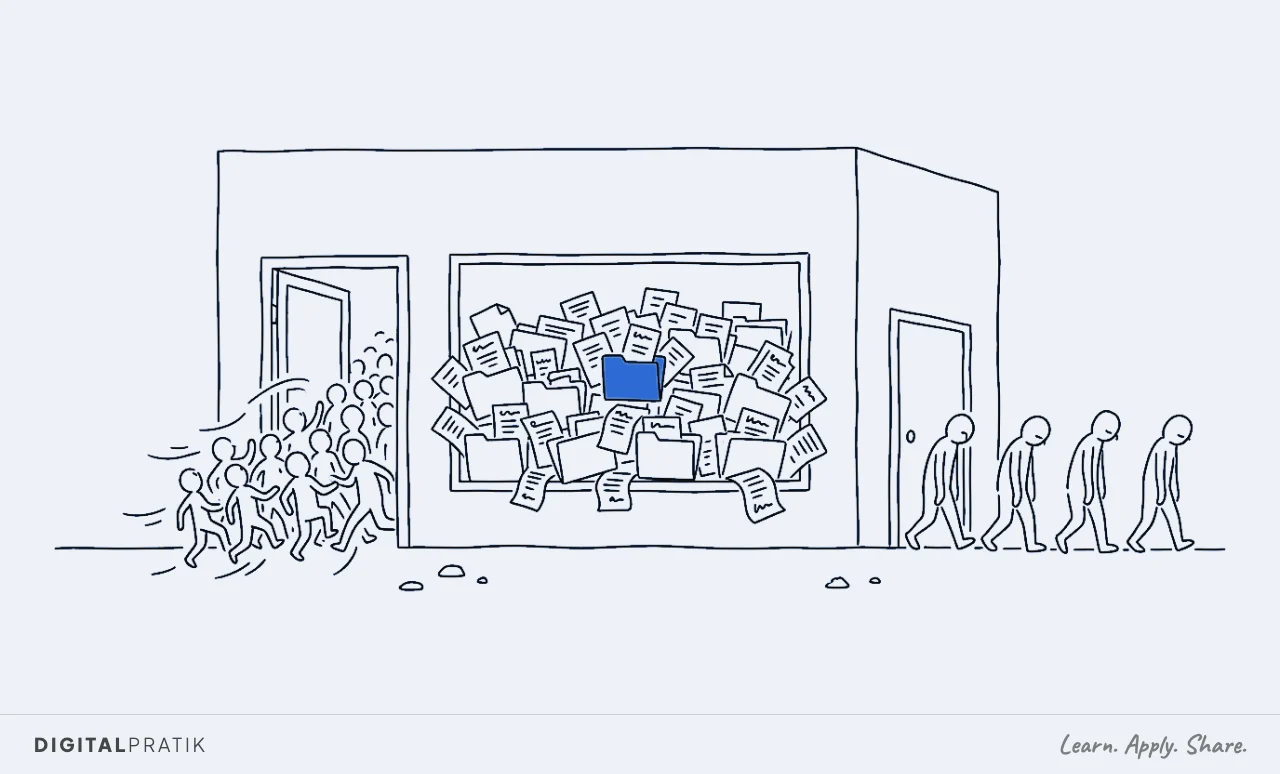
Which brings up the trap almost every growing club falls into. They try to grow by pouring in more new signups, into a club whose whole experience still runs through the owner.
That does not produce a bigger, healthier club. It produces a leaky one, where new members arrive at the front while just as many quietly walk out the back because nobody had the capacity to keep them warm.
This is the capacity problem, and it is one of exactly three things almost every stuck business is stuck on. The other two are getting the right members in and converting them, and I have written the full diagnostic in the 3A Machine.
So the goal of deploying agentic AI in a club is not "use AI to sell more shakes". It is to build the capacity that lets you grow the room without the experience falling over.
Get these nine steps running and the same owner and the same small team hold two or three times the members without a single one drifting away unnoticed, without a receipt going unmatched, without a reorder going uninvoiced. Fix the capacity first, so the members you already fought to win actually stay, and then go and win more.
The nine steps, in three phases
Here is the whole map on one page. Your club already runs all nine of these jobs today, whether or not anyone has ever named them.
The framework does not add work to the pile. It names the jobs, then decides one at a time whether a person does each one or a system does it.
| Step | Phase | The job it does |
|---|---|---|
| 1. Diagnose | Before build | Quantify what is bleeding: members who stop checking in, memberships lapsing, product orders never invoiced, hours lost chasing receipts in a chat |
| 2. Shadow | Before build | Follow one real member from signup to renewal and excavate the unwritten rules |
| 3. SOP | Before build | Turn the recording into a written procedure a machine can read, including a new-member onboarding checklist |
| 4. Baseline | Before build | Agree the current numbers, in writing, before you change anything |
| 5. Command center | Build | One screen: the member radar, the follow-up clock, the unbilled orders, the document wall |
| 6. Procedure as data | Build | The club's mind: every onboarding rule, plan, follow-up cadence and past answer, searchable |
| 7. The club assistant | Build | Reading receipts, matching orders and drafting check-ins, working the procedure under four safety rules |
| 8. Handover | Removal | The team approves instead of performing: briefs, drafts, activity, drop-off alerts |
| 9. Removal | Removal | The owner steps out of the routing. The weekly proof shows the system earning its keep |
Notice the shape. Four steps happen before anybody builds anything, and skipping them is the single most common reason a club's "let us try some AI" project quietly dies.
People buy the exciting part first, a bot, point it at nothing in particular, and end up with a fast tool that has no idea how the club actually runs, who a lapsing member is, or what a proper onboarding looks like. The order below is built to stop exactly that.
Step 1. Diagnose: find what is actually bleeding
You cannot fix what you have not counted, and most clubs have never counted this. So the first step is a leak audit, and its only job is to put a number on the money already walking out of the club.
Not a survey of how everyone feels about the vibe. A count of losses.
In a nutrition club the leaks are always in the same few places. Members who stopped checking in and were never contacted, then quietly let the membership lapse, and the lifetime value that walked out with each of them.
Memberships that expired because nobody sent the renewal message in time. Product orders that were handed over the counter and never made it onto an invoice, which in a club is almost always bigger than the owner guesses, because a top-up here and a booster there feel too small to chase in the moment and add up to a serious number by month end.
And the hours the owner burns every single week scrolling a group chat to work out who paid, who is due, and who has gone worryingly quiet.
Add it up honestly and the total is almost always larger than expected, and concentrated in two or three places rather than spread evenly. That concentration is the gift.
It tells you exactly where to point the build first, and it becomes the before number you use, right at the end, to prove the system paid for itself. On the member radar this is the line that reads fifteen members not checked in and six thousand two hundred dollars of orders not yet billed.
Those are not abstractions. Each one is a specific person and a specific unraised invoice.
Step 2. Shadow: follow one member from signup to renewal
Now you watch. Pick one real member journey, ideally a fresh signup, and follow it end to end, writing down every single thing that happens and every decision anybody makes.
The day they walk in. The consultation where you set their goal.
The plan you build. The first product order.
The check-ins across the first weeks. The moment their membership comes up for renewal.
Not the tidy version you would describe to a new coach. The real one, with all its gaps.
This is where you discover the club does not run on a written process. It runs on a hundred unwritten rules that live in your head and, more than anywhere else, in the group chat and the direct messages.
Which member always pays late and always pays. How long a member can go without a visit before they are genuinely at risk rather than just busy.
Which plan you quietly upgrade people to once they hit a certain point. The reorder rhythm for a daily-shake regular, so you know almost to the day when they will run out.
The way you always add a new member to the group before you consider them properly onboarded. None of it is written down, all of it is load-bearing.
The excavation is the real work of this step. You read back through the threads and pull out the rules the club actually operates on, the ones that were never a decision, just a habit that turned out to be right.
That messy, lived-in reality is what you are about to encode. Skip it and you will automate a fantasy version of the club, one where every member is a tidy monthly subscriber who never misses, ship it, and then watch it send a cheerful renewal message to someone who stopped coming a month ago.
And be honest about the fragility this surfaces. In most clubs the real operating manual is one person's memory, and it walks out the door the day that person burns out or steps back.
Step 3. SOP: write the unwritten procedure down
Everything you excavated now becomes one written procedure. Plain language, step by step, in the order it really happens, with every rule and every exception stated.
This is the least glamorous step in the framework and it is the one that makes an agentic system possible, because a club assistant can only work a procedure that has actually been written.
The most important piece here is the new-member onboarding checklist, because onboarding is where retention is either won or lost in the first week. Written down, it stops being a thing you "usually" do and becomes a hard gate.
A member is not onboarded until six things are true: a goal consultation has happened, a plan is agreed, the membership is signed, a first product order is placed, a check-in schedule is set, and the member has been added to the group. Written as a procedure, the fuzzy welcome becomes a checklist a machine can enforce every single time, so no new member ever falls through the crack between "they signed up" and "somebody actually looked after them", which is exactly where most early churn hides.
The same goes for the follow-up cadence and the renewal flow. How many days of silence trips a check-in.
When a reorder reminder should go out relative to when the product runs low. How long before a membership date the renewal conversation should start.
Each becomes a written rule rather than a thing you simply carry in your head. Write it for a smart new team member on their first day, not for a machine.
If a person could follow it without asking you a single question, a system can run it. If it still needs somebody to "just know", the procedure is not finished, and you are not ready to build.
Step 4. Baseline: agree the numbers before you touch anything
The last step before the build, and it is thirty minutes that saves you a year of arguments. Write down the current numbers and agree them with yourself and anyone helping you run the place.
How long it takes to match a payment receipt to the right member and mark it paid today. How many members, right now, have not checked in for over a week and have had no contact.
How much product has been handed over and never invoiced this month. How fast a new signup actually gets a plan and a first order.
Real numbers, honestly rounded, on the record.
You do this for one reason. In three months, when the system is running, memory rewrites history.
You will forget how bad it was, decide it was "always basically fine", and start to wonder what you are paying for. The baseline is the receipt.
It is what lets the weekly proof report at the end say "matching a payment to a member went from about twenty minutes of scrolling to about two" and have that land as a fact you agreed up front, rather than a vendor's claim you have to take on trust.
It is also the moment to decide what "better" means for this club, so the build aims at a number and not a vibe. A club bleeding on quiet members who slip away is not chasing the same win as one drowning in uninvoiced reorders.
Name the number now. It is what everything you build next is pointed at, and it is the difference between "we bought some AI" and "we recovered this specific leak".
Step 5. The command center: the whole club on one screen
Now you build, and the first thing you build is the place the owner looks. One screen that shows the whole club at a glance, in the order that costs money, so nobody reconstructs the state of the club from a group chat, a payment app, a spreadsheet and their own memory every single morning.
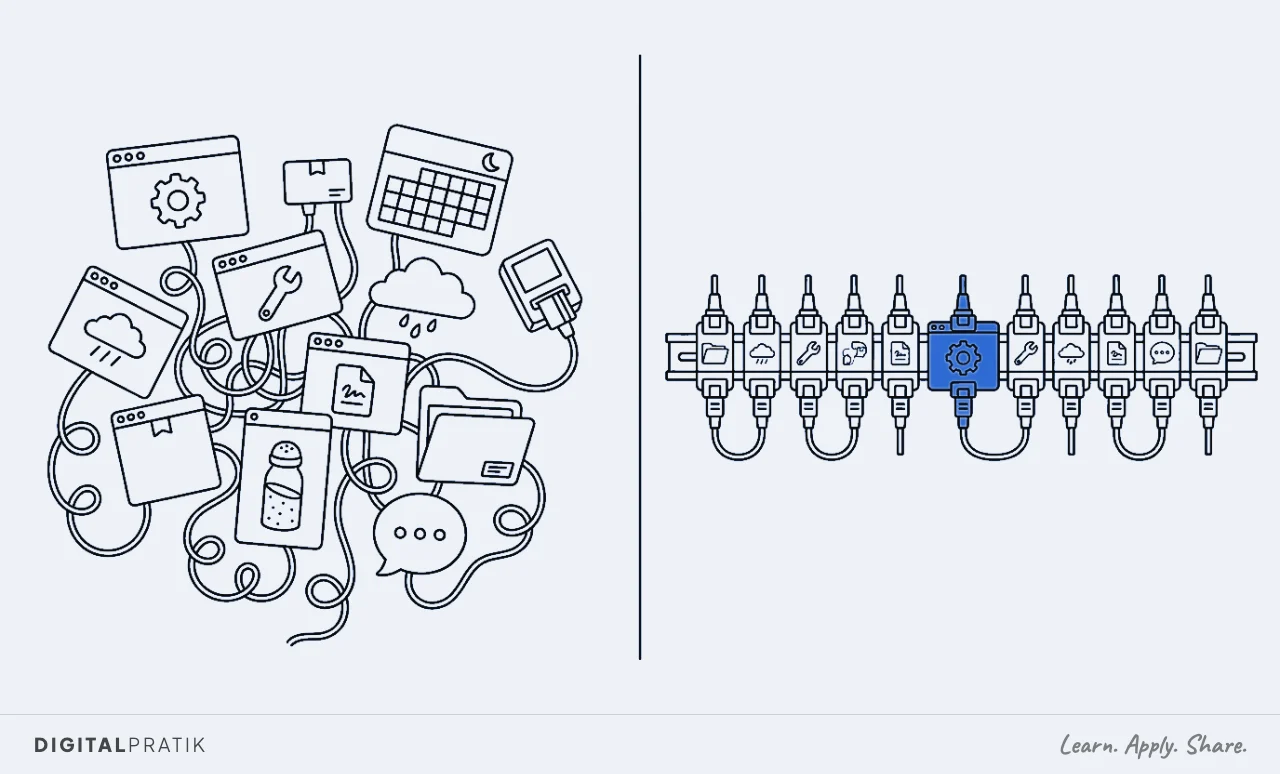
Build it on one spine, not twelve tools. This matters more than it sounds.
Every job in the audit is tempting to solve with its own separate app, a booking app here, a payments app there, a messaging tool, a spreadsheet for reorders, and a year later you have a drawer full of subscriptions that do not talk to each other and an owner who is now the integration layer between them, copying a name from one into another by hand. Build the whole thing on one foundation, one place where the members, the money and the context all live, and the next piece is nearly free because everything it needs already exists.
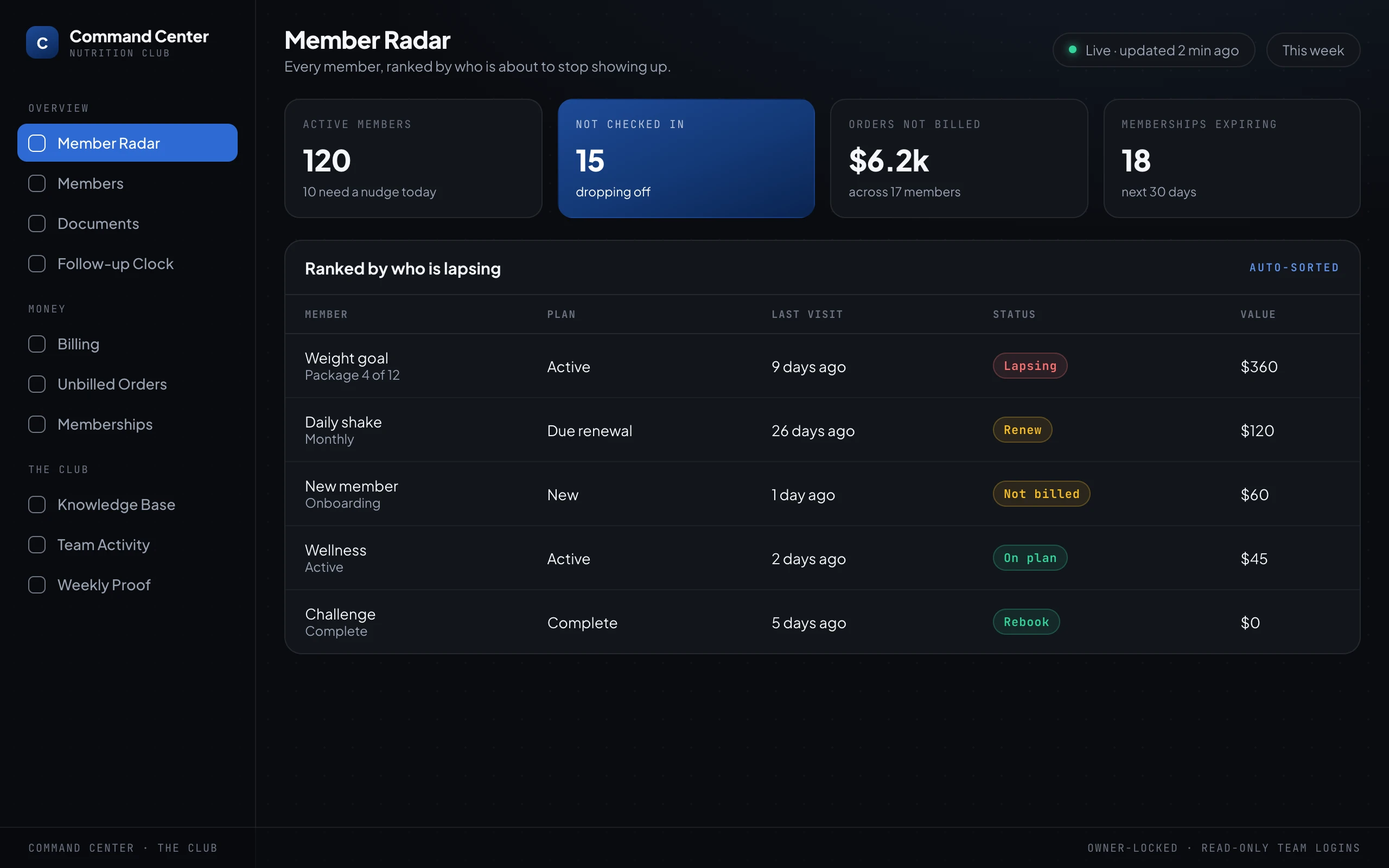
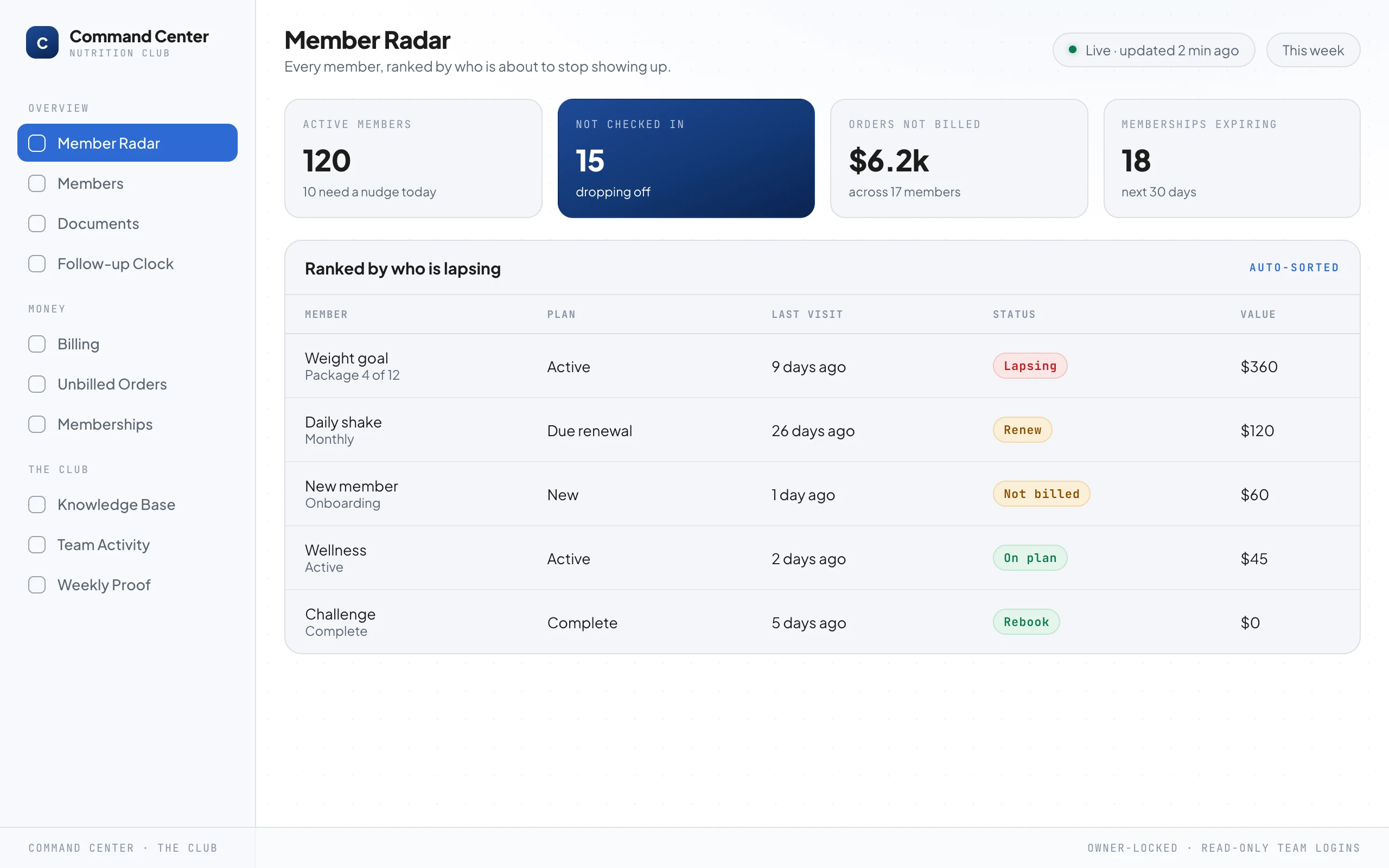
The centre of the screen is a member radar: every member, ranked not alphabetically but by who is about to stop showing up. The weight-goal member who has not been in for nine days sits at the top, flagged as lapsing, whether or not anybody thought to look.
Around it, the numbers an owner actually needs, the count of active members, how many need a nudge today, how much product is sitting delivered but unbilled, and how many memberships are due to expire in the next thirty days.
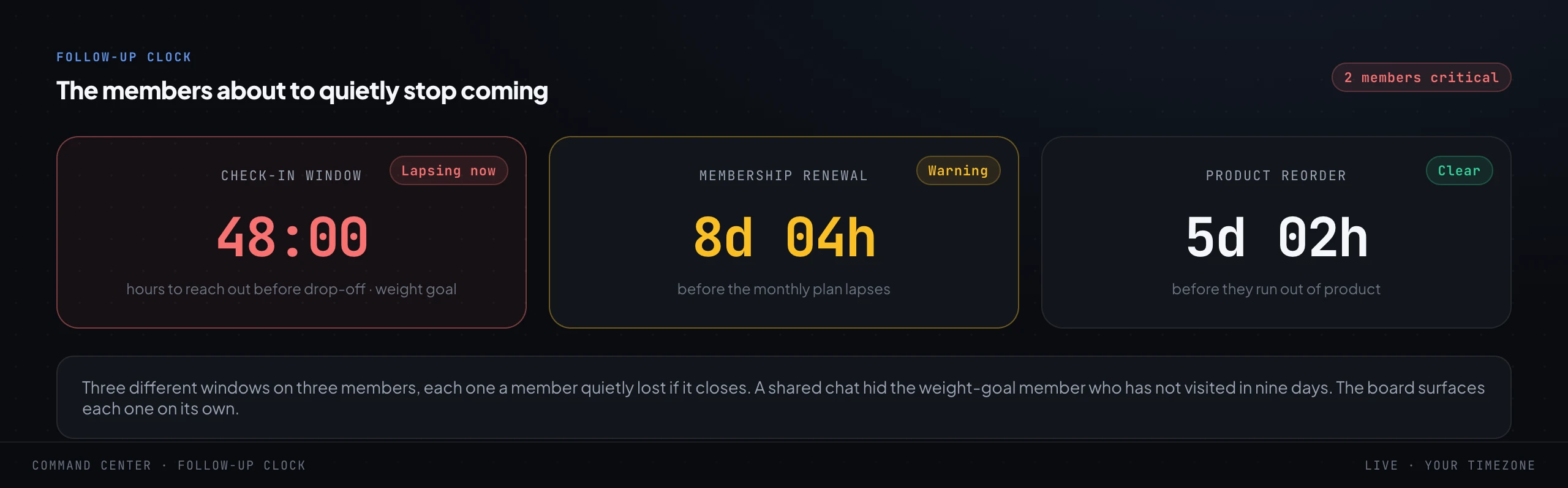
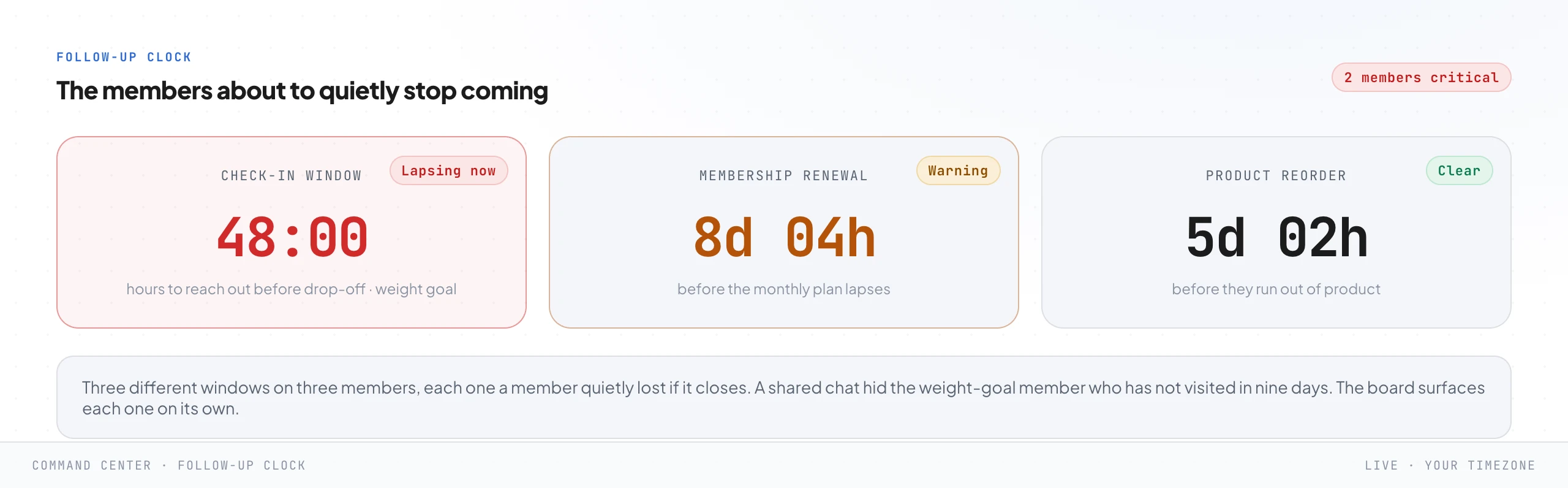
Then the follow-up clock. A club does not have one deadline, it has dozens running at once across every member, and they are three completely different kinds of window that a single group chat flattens into one comforting blur.
There is the check-in window, the hours you have to reach a quiet member before drop-off becomes likely. There is the membership renewal window, the days before a monthly plan lapses.
And there is the product reorder window, the days before someone runs out of what keeps their routine going. The command center pulls them apart and shows each on its own clock, so the member who is forty eight hours from being genuinely lost does not hide behind the calm ones.
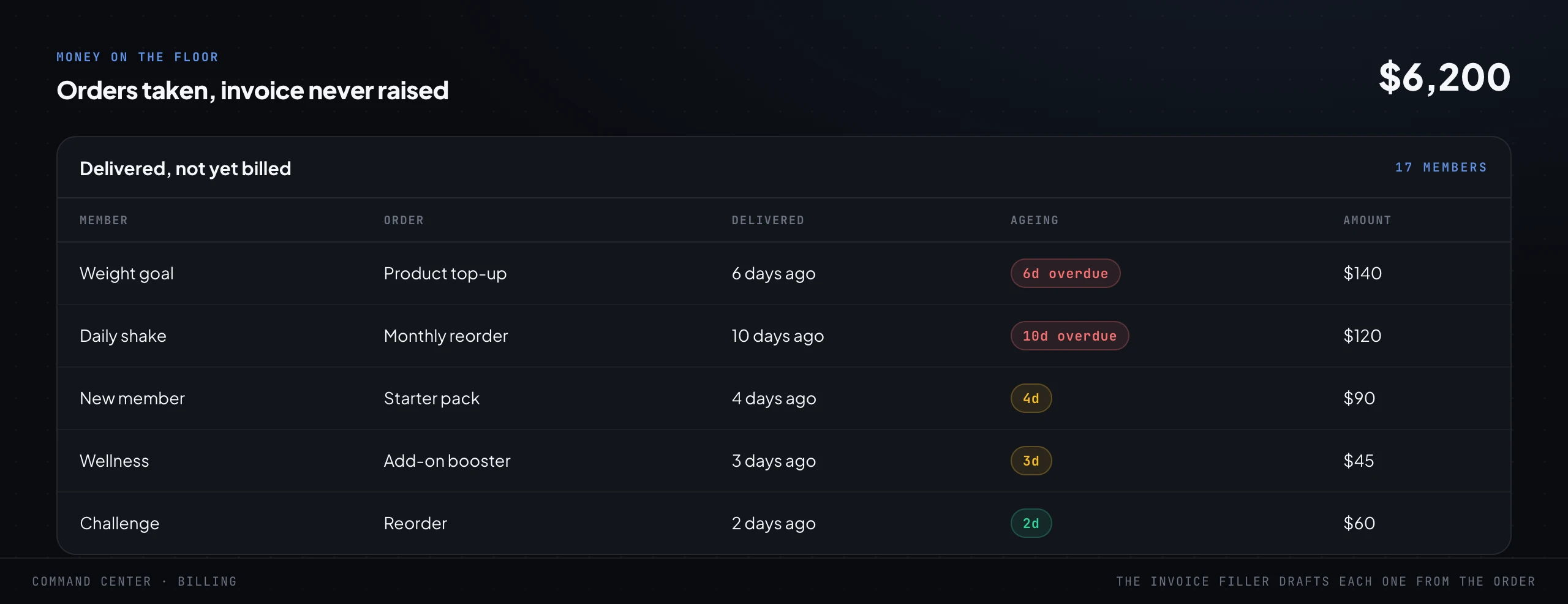
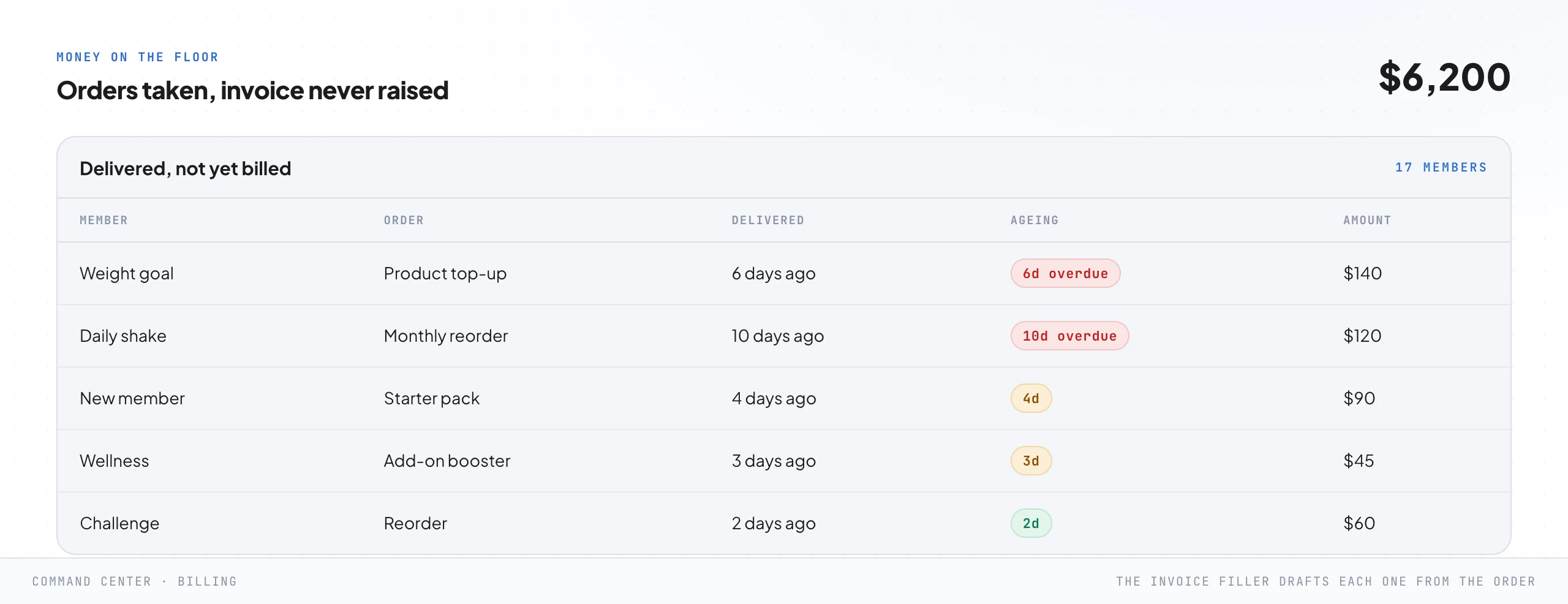
Beside the clocks, the money on the floor: every product order handed over and never invoiced. In most clubs this is a genuinely uncomfortable number the first time it appears on a screen, because the product already left the shelf and the effort was already spent, and simply nobody raised the invoice.
It was not a discount decision. It was that raising the invoice was a small, annoying, easily-forgotten job in the middle of a busy session, which is a fair description of most of what leaks in a club.
Six thousand two hundred dollars across seventeen members is not a strategy. It is seventeen invoices nobody got round to.
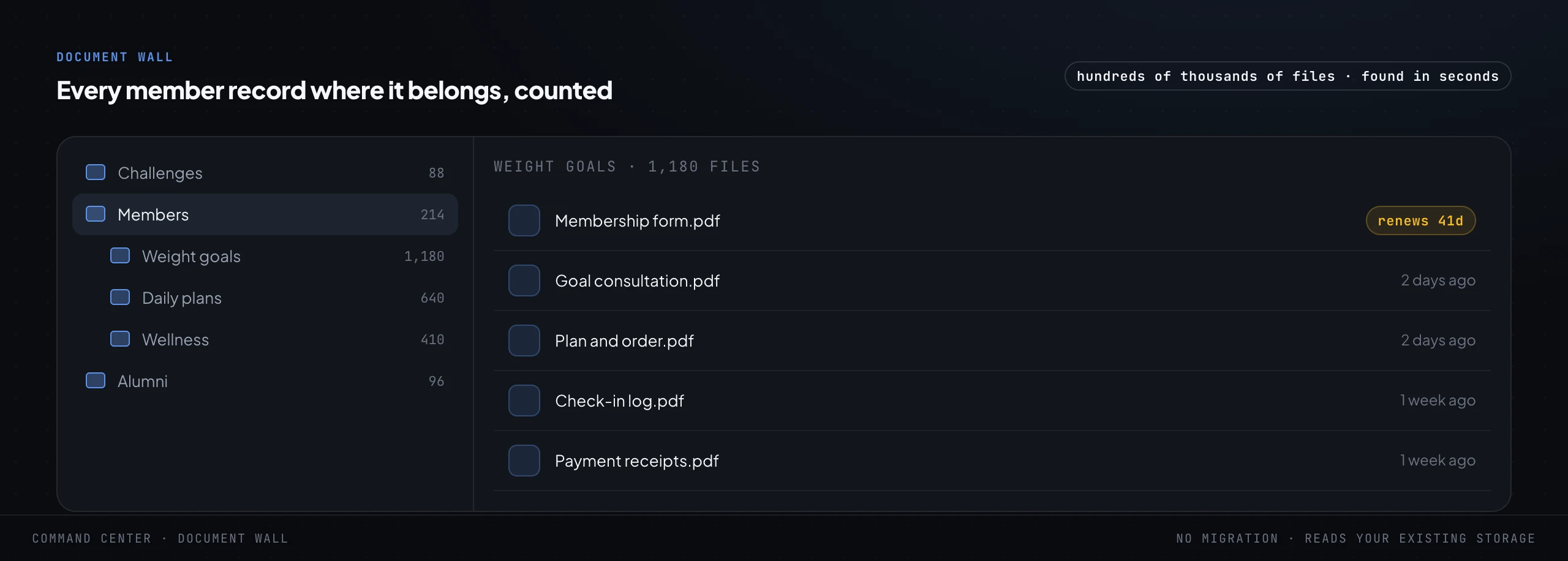
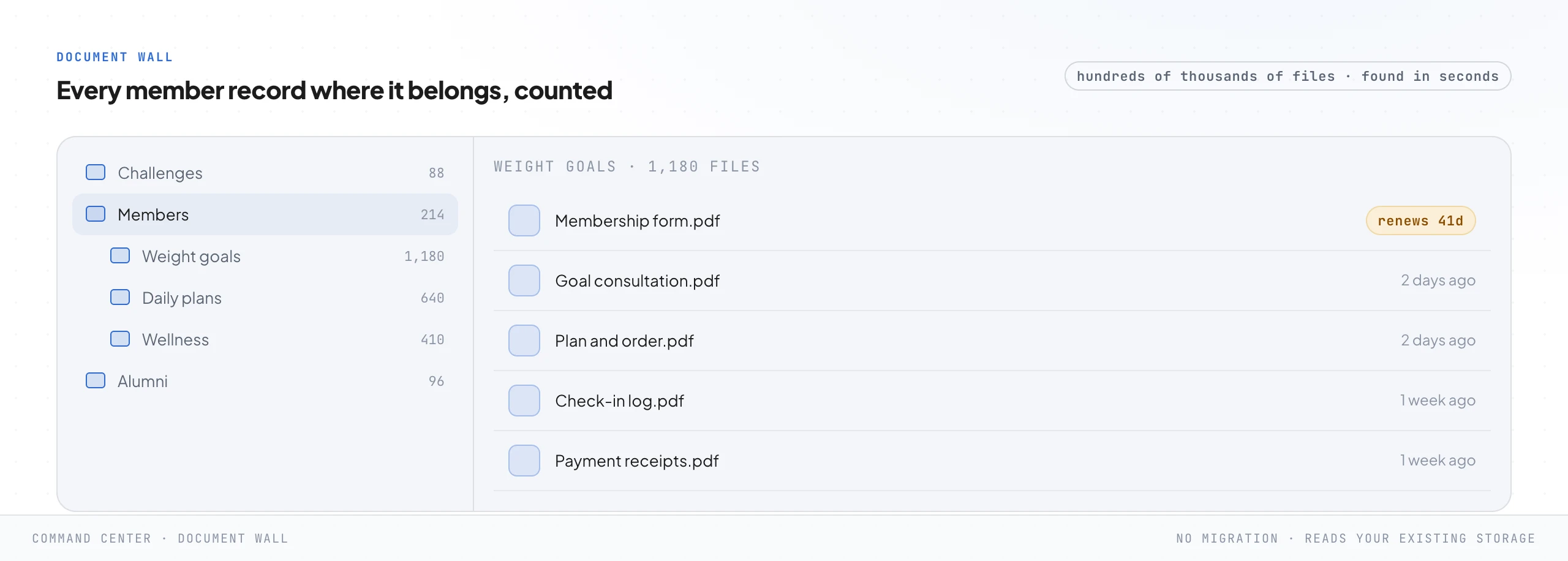
And the document wall. An established club is sitting on a surprising pile of member records, membership forms, goal consultations, plans, check-in logs and payment receipts, scattered across a phone, a chat and a folder nobody has fully organised in years.
The command center reads that existing storage where it already lives, with no migration and no "please move everything into our new system", and makes it navigable and countable, so any member's membership form or last receipt is found in seconds instead of a frantic scroll while the member stands at the counter waiting.
One design choice worth naming, because owners always ask. The command center is owner-locked, and the team gets read-only logins scoped to what they need.
The owner sees the money and the whole board. A helper on the desk sees the members and the check-ins assigned to them.
Nobody can quietly change a number they should only be reading, and the owner never loses the single honest view of the club the whole build exists to give them.
Three things run underneath all of it, quietly. The whole system is backed up on a schedule, so a bad day is never a lost day.
It is locked down so the data only ever answers to the people you named. And a heartbeat watches the system itself: if a job that should run every morning goes quiet, you hear about it before a client does.
None of this is glamorous and all of it is why you can actually trust the thing to run without you standing over it.
Reading the map and walking it are different jobs. If you run a club or a membership business doing AED 10 million a year or more and you are still the operating system, this is what a working session looks like.
Step 6. The procedure as data: the club's mind
The procedure you wrote in step 3 is a document, and a document just sits there. In step 6 you turn it into data the system can reason over: every onboarding rule, every plan, every follow-up cadence, every renewal policy, and every good answer the club has ever given, connected by meaning rather than buried in a chat history.
This is the club's mind, and it is what makes the club assistant in the next step sound like your club instead of a generic model reading off the internet.
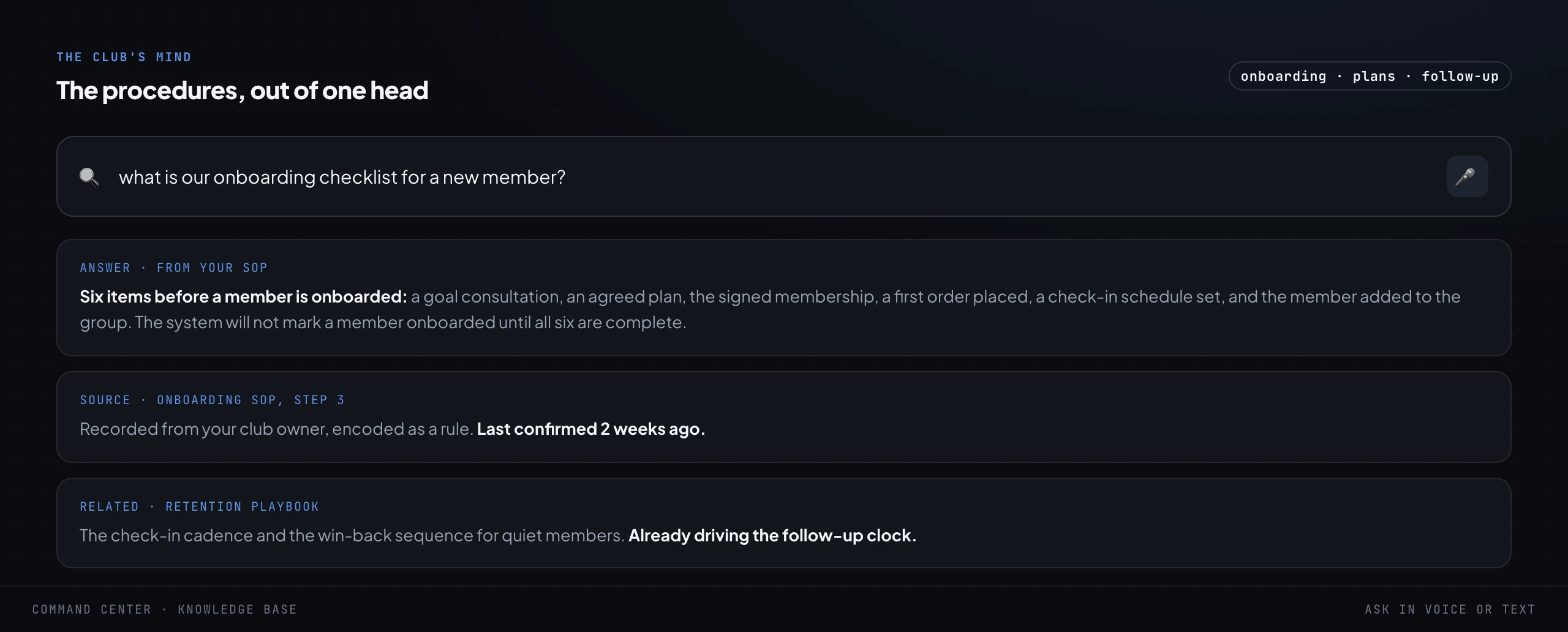
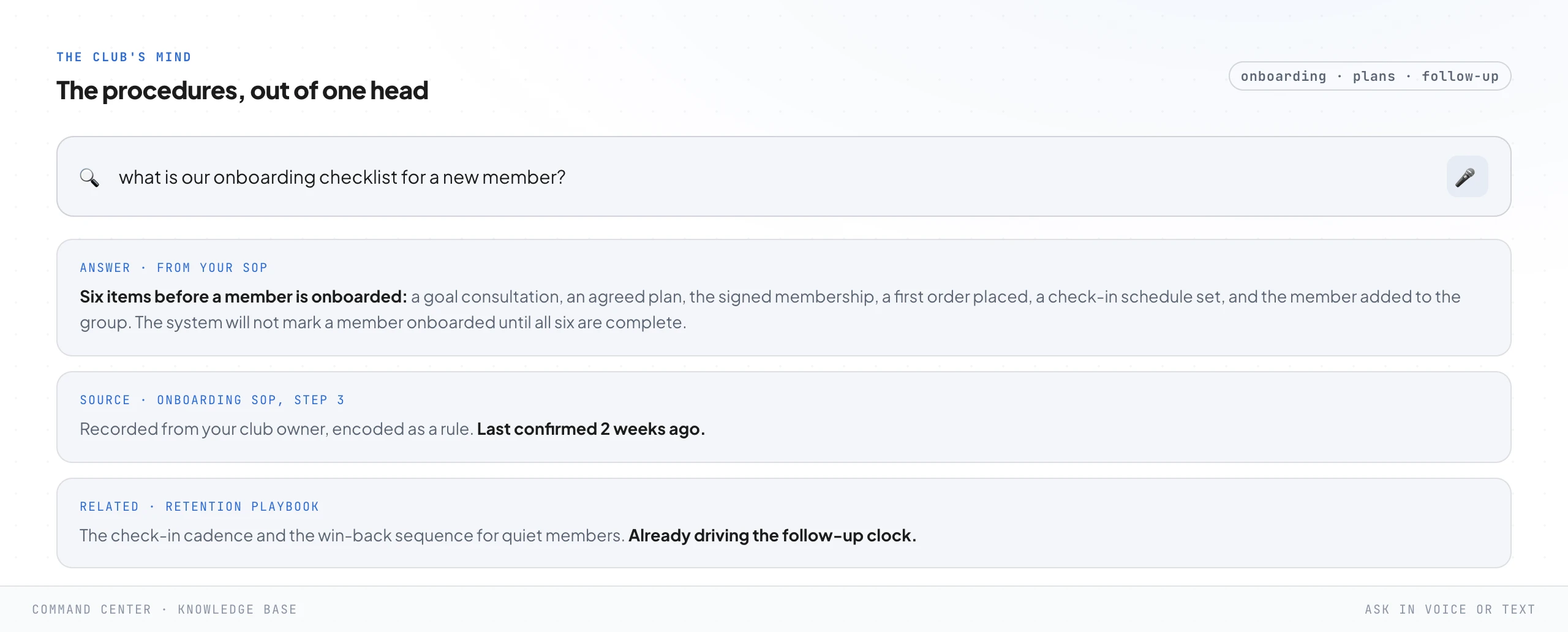
In practice it means anybody can ask a plain question and get the club's own answer. What is our onboarding checklist for a new member.
How many days of no check-in counts as lapsing for us. What is our win-back sequence for a member who has gone quiet.
The answer comes back grounded in the club's own written procedure, with the source it came from, so it is checkable rather than a confident guess. Ask for the onboarding checklist and it returns the exact six items, a goal consultation, an agreed plan, the signed membership, a first order placed, a check-in schedule set, and the member added to the group, and it tells you the system will not mark a member onboarded until all six are done.
The reason this matters more than it looks is drift. A general model, asked the same question twice, will happily give two confident and slightly different answers, and in a club that means two members onboarded two different ways, or two different definitions of when someone counts as lapsing.
Grounding every answer in the club's own written procedure kills it. The system is reading your rules and quoting them with the source, and when you change a rule, say you decide seven days of silence is now the trigger instead of nine, you change it in one place and every answer, every clock and every draft changes with it.
It is also where the onboarding checklist becomes enforceable rather than a nice idea, because the club assistant in the next step reads its gates from exactly here.
Step 7. The club assistant: reading, matching and following up on time
Now the part people picture when they hear "AI". An employee, not a chatbot, and the distinction is the whole thing.
A chatbot waits to be asked. An employee wakes on a timer, reads the live state of the club, does its round, files the work, and flags what needs a human, whether or not anybody prompted it.
I have written the longer version in AI employees, not chatbots.
In a club it is a small crew of them, each with one job, all reading from the club's mind. A receipt matcher that reads a photographed payment receipt, works out which member and which membership it belongs to, marks the order paid and resets that member's renewal clock, all from a single photo dropped into the chat.
A refusal fence that will not let a new member be marked onboarded until every item on the checklist is genuinely complete. A follow-up drafter that watches the check-in windows and, the moment a member goes quiet, writes the personal "we missed you" message ready for a human to approve.
And a talking agent that answers a member's question, in their own language, about their plan or their next order, without pulling you off the person in front of you.
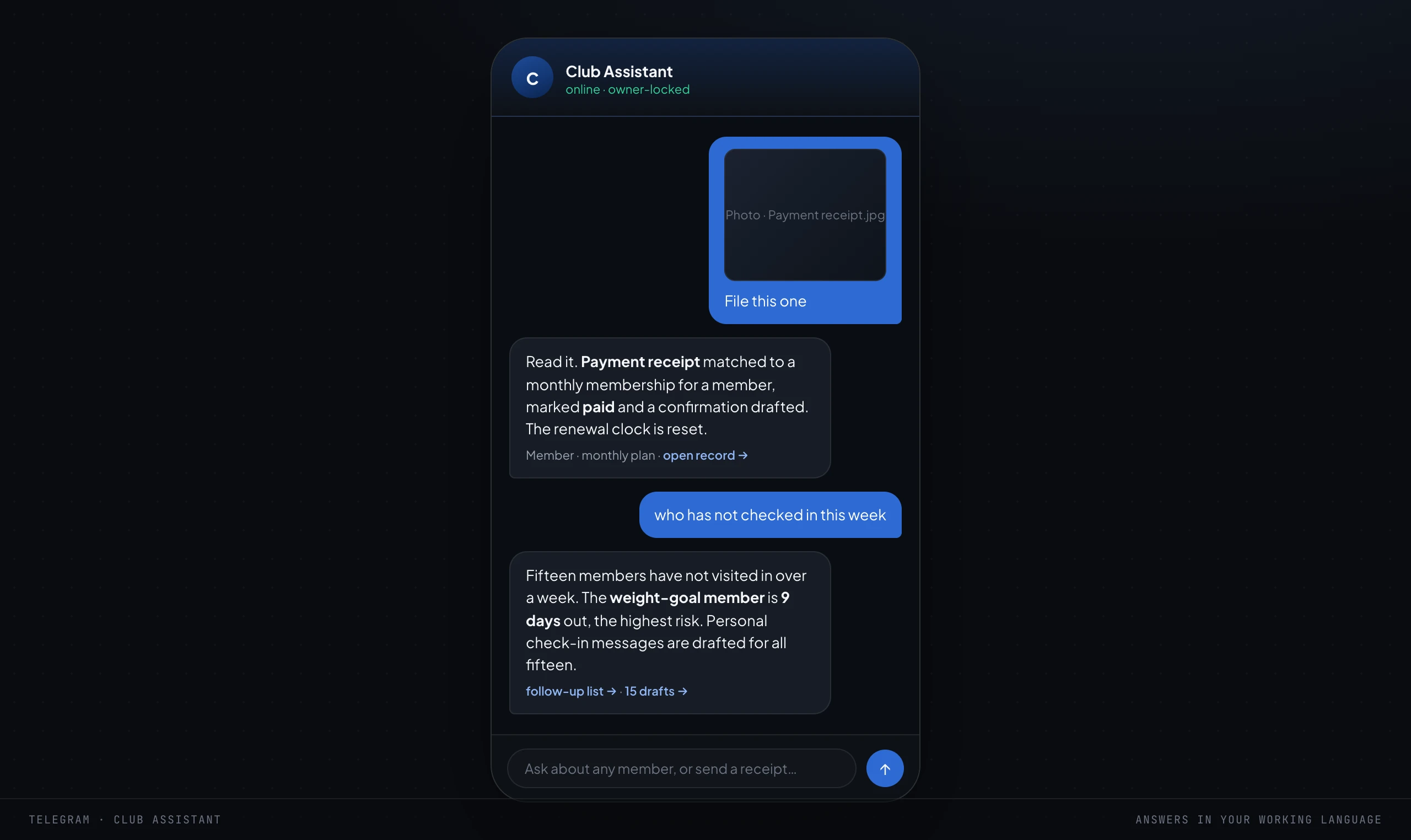
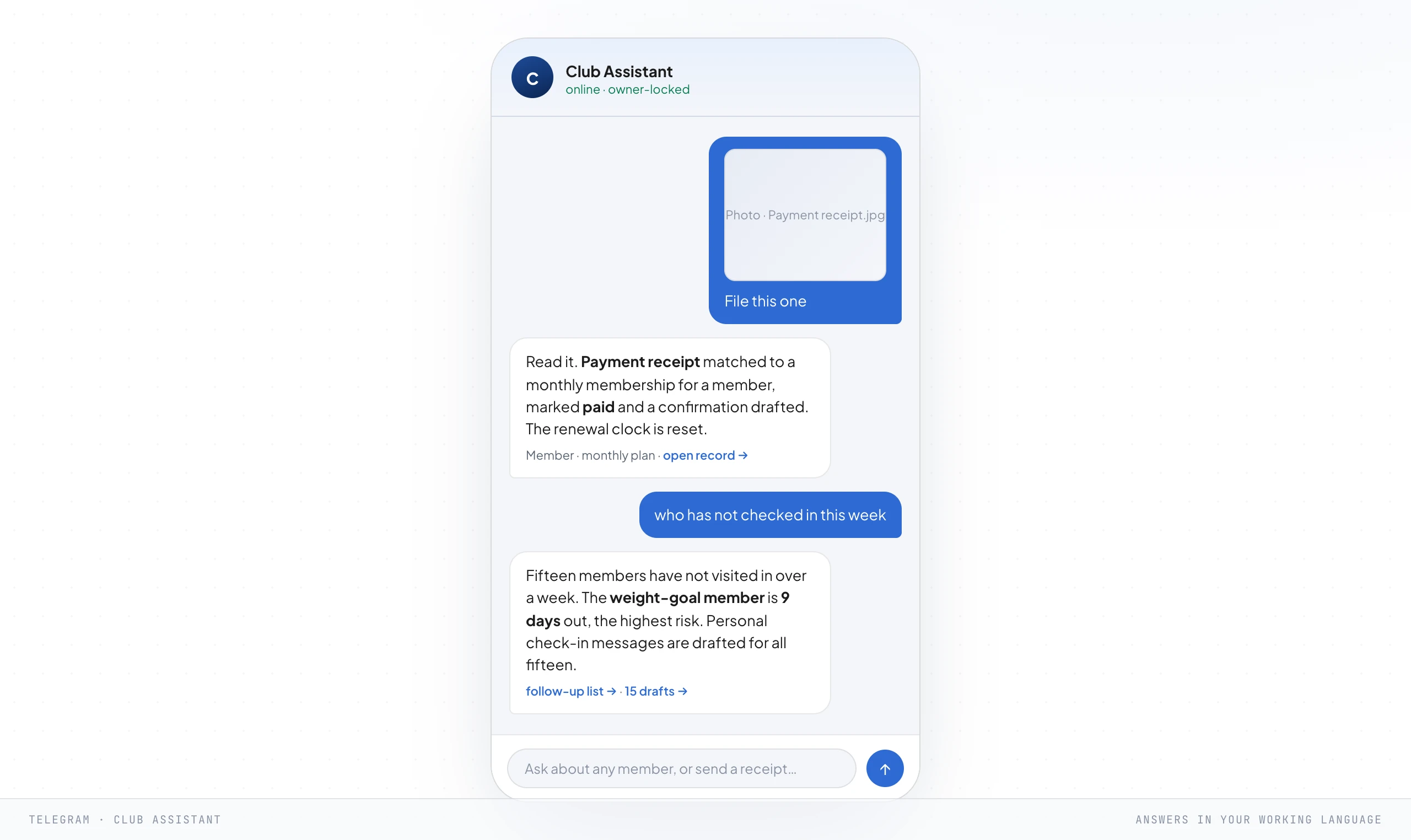
There is a quieter agent in this crew that owners never ask for and always end up valuing most: a critic. Before any piece of work reaches a human, a second agent grades it against the procedure.
Did the receipt actually match the right member. Is this really a lapsing member or just someone on holiday who told us.
Is this new member genuinely onboarded on all six items or only five. Anything that fails goes back to be redone before you ever see it.
This is the line between AI you can run and AI you can trust with a member's money and a member's trust, both of which are hard to win back once a system gets them wrong.
An employee that can act is useful and it is also dangerous, so this step ships with four safety rules and they are not optional. They are the reason you can hand a system this much and sleep.
- It refuses out-of-procedure work. If a receipt does not clearly match a member, or a request does not match the written procedure, the assistant declines and escalates rather than improvising. It will not mark a member onboarded on a partial checklist. The refusal fence is a feature, not a failure.
- Every file operation stays inside set boundaries, and deletes go to a recycle bin. It cannot reach outside the member folders it was given, and nothing it removes is ever truly gone. A receipt matched to the wrong member is always recoverable.
- Every member-facing message waits for a human yes. It drafts the check-in, the renewal reminder, the reorder nudge, the invoice, then stops. A person reads it and presses send. Anything that touches a member, their money or the club's name gets a human on it first.
- Ambiguous figures and dates come back empty, never guessed. If it is not sure which membership a payment belongs to, or when a plan actually renews, it says so and asks. A blank is safe. A confident wrong figure marked paid, or a renewal message sent to someone who already cancelled, is how a system does real damage to a relationship.
Two things make that crew safe to hand real work to. First, each agent is given a narrow, controlled connection to the business's own tools, its files, its records, its calendar, and nothing beyond them.
It works inside your systems, so it answers from your firm rather than the open internet, and it cannot wander off to touch anything you did not hand it. Second, every action it takes comes back as a receipt: a short note in the chat that says what it just did, so nobody is ever guessing what the system touched.
All of it runs on Claude, the model we build everything on.
Step 8. Hand it to the team
The build is running. Now it stops being the owner's private tool and becomes how the whole club works, and the shift is subtle but total: people move from performing the work to approving it.
The system does the first pass of everything, reads the receipts, spots the quiet members, drafts the check-ins and the invoices, and a person says yes, tweaks a message, or sends it back. Same team, far more members looked after, and you are left doing the coaching and the relationships that were always the actual job.
That handover is made of a few specific things. A follow-up drafter that writes the check-in a quiet member is owed, ready for a person to approve.
An activity wall so the owner can see what the system and the team did without asking anybody. A change watcher that notices when a member who used to come daily has gone quiet, or when a membership date has slipped past without a renewal.
And the piece everyone feels first: the morning brief.
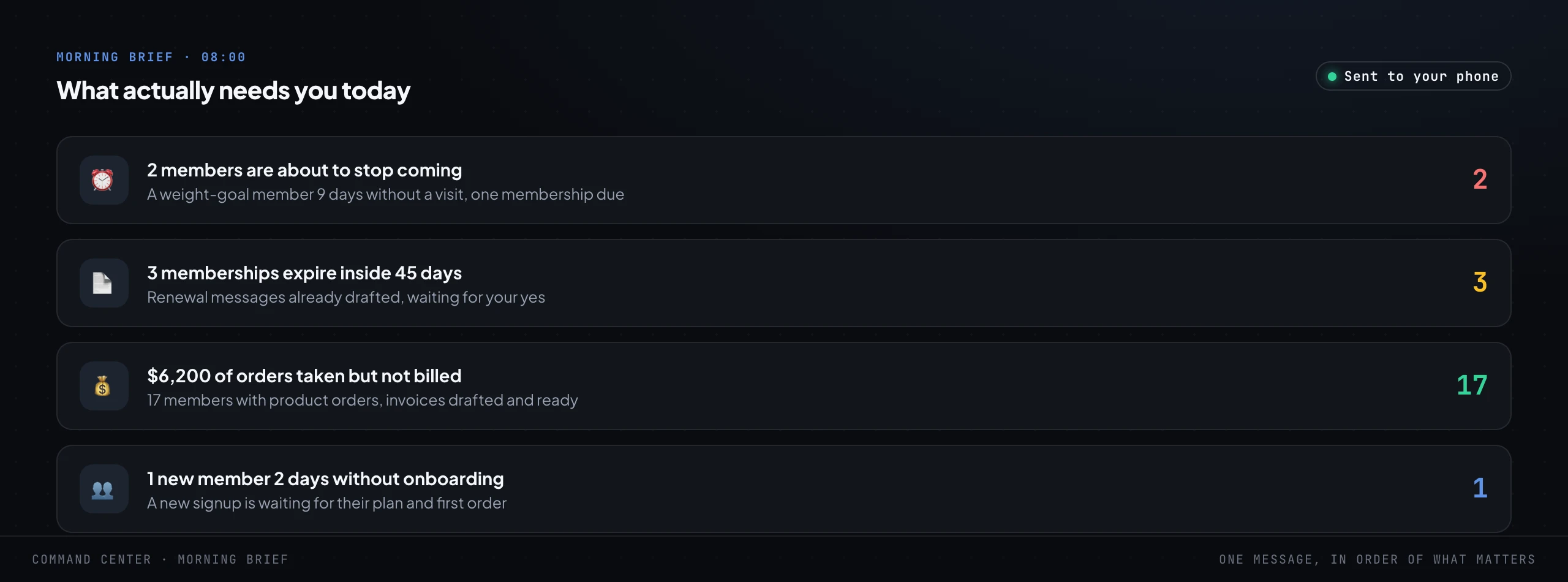
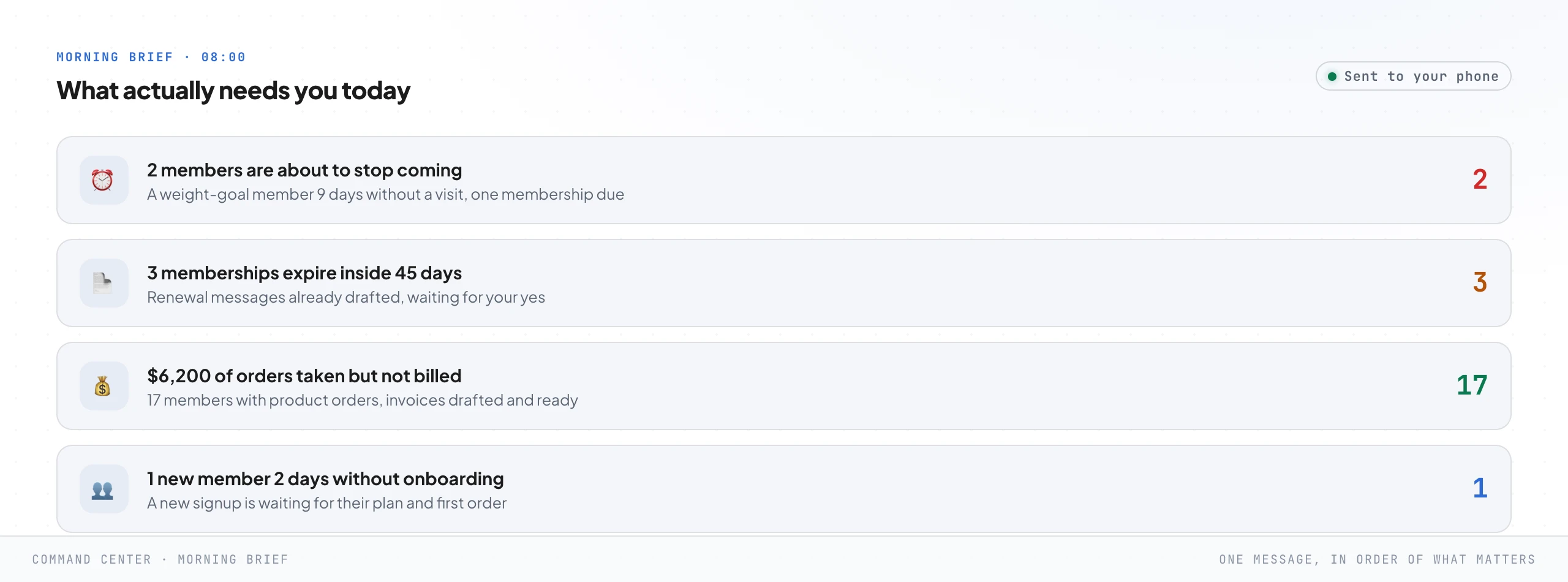
At eight in the morning, before anyone opens anything, one message lands in order of what matters: here are the two members about to stop coming, one of them nine days without a visit, here are the three memberships expiring this month with the renewal messages already drafted, here is the six thousand two hundred dollars of product orders waiting to be invoiced, and here is the one new member who signed up two days ago and still has no plan. The team walks in already knowing the day instead of spending the first hour of it scrolling to discover the day.
A word on the human side, because it decides whether any of this sticks. The word removal frightens a team, and if they think it means removing them, they will quietly starve the system of the knowledge it needs.
It does not mean that. It means removing the receipt-scrolling, the guessing at who has gone quiet, the frantic hunt for a member's form at the counter, and leaving people with the coaching and the community-building that were always the real work of a club.
Say it out loud, early and often. A team that believes the system is on their side will feed it.
A team that fears it will fight it, and win.
Step 9. Removal is the whole point
Here is the step everyone gets wrong, and it is the reason the framework exists. Step 9 is not training.
It is removal. The goal was never to teach the owner to use a clever new tool.
It was to take the operating-system job out of the owner's head, so the club stops running at the speed of one person's attention and no member is ever quietly lost because the owner was busy with the person in front of them.
You know you have reached it by a specific test: the owner can take a genuine week off and nothing leaks. Receipts still get matched and marked paid.
Quiet members still get their check-in, in the club's own warm voice, before they drift. Memberships still get renewed on time.
Reorders still go out before anyone runs low. New members still get onboarded properly on all six items.
Nothing waits for one person to come back and look, because that person is no longer the thing the whole club runs through. The owner approves the exceptions from their phone, or they do not, and it holds either way.
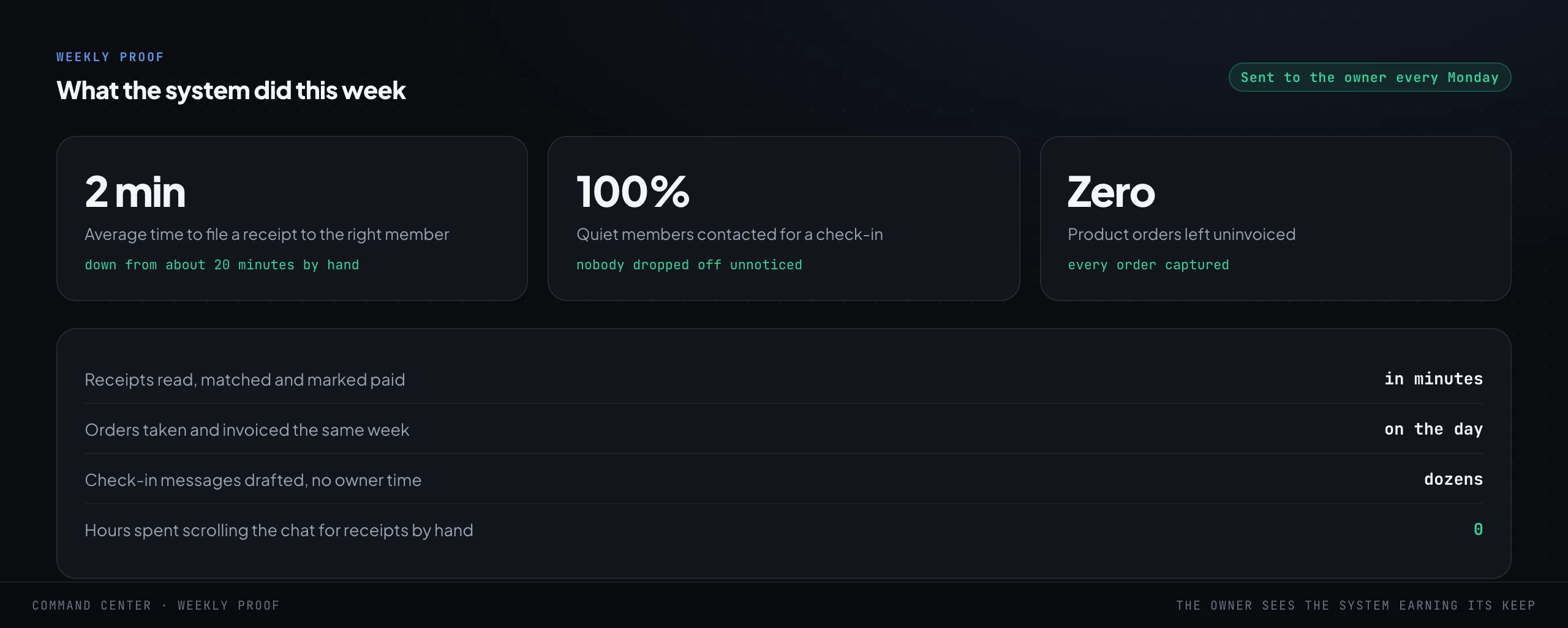
And this is where the baseline earns its keep. Every Monday a proof report goes to the owner and says, in the numbers agreed at the start, what the system did this week.
A payment matched to a member in about two minutes instead of twenty of scrolling. Every quiet member contacted, so nobody dropped off unnoticed.
Zero product orders left uninvoiced, every one captured. It is not a dashboard somebody has to remember to go and check.
It is the system reporting to the owner, unprompted, on whether it is still earning its keep.

And then the question that is really the point: what does the owner do with the attention they just got back. In every club the honest answer is the same, and it is why this belongs on a growth marketing site.
They go and do the work only the owner can do. Coaching the members who need it most, running the challenges that build the community, showing up for the people who make the place what it is, and yes, going out and winning more of the right members, now that there is finally capacity to keep them.
Removal is not the end of the owner's involvement. It is the first time the owner gets to actually build the club rather than just hold it together.
What it costs to run
This is the question every owner asks within about ninety seconds, and the honest answer surprises people in the right direction. It is far less than they expect, and far more transparent, because the running cost is metered and shown like a utility bill rather than hidden inside a flat monthly fee.
For a working system on a real club's volume, the AI usage runs on the order of a few dollars a day, and the hosting and database are a few tens of dollars a month, so the whole thing comes to roughly a hundred dollars a month to run. Your volume will differ, which is exactly why the meter is built in from day one and shown to the owner on day one.
No hidden meter, ever.
Now put that next to what it replaces, with round numbers you can redo with your own. Say the owner loses two and a half hours a day to scrolling the chat for receipts, working out who has gone quiet, and chasing reorders and renewals by hand, across twenty two working days.
That is fifty five hours a month. Value that time at even a modest fifty dollars an hour, low for the one person the club depends on, and it is over two and a half thousand dollars a month of attention, against roughly a hundred dollars to run the system that gives most of it back.
And that ignores the two biggest wins, because neither shows up as time saved: the member who did not drift away because the check-in actually landed, and the product order that finally got billed. Those show up as revenue that did not leave.
Where to start on Monday
Nobody builds all nine steps at once, and you should not try. This is a map, not a project plan, and the map is useful the moment you have it, because it tells you where you are and what the next single step is.
So do not start with the screen that impressed you most. Start with the step the audit said is bleeding worst.
If product orders keep getting handed over and never billed, the money-on-the-floor wall and the receipt matcher pay for the whole build inside the first month. If members are quietly slipping away, start with the member radar and the follow-up clock, so no quiet member is ever invisible again.
If your day is eaten by scrolling a chat to match payments, start with the club assistant reading receipts. The full logic for choosing the first thing is in what to automate first in a service business, and the honest way to measure whether it worked is in true ROI versus reported ROAS.
One thing at a time. Diagnose, build the one piece that hurts most, put a human gate on anything irreversible, then the next piece, which will be cheaper than the first because it sits on the same spine.
That is the whole method. This same framework runs in an accounting firm, a clinic, a law practice and a shipping business, the labels on the screens change and the nine jobs do not, and the full walk-through of the general version is in the 9-step framework for deploying agentic AI.
The clubs that end up with a real system instead of a phone full of half-used apps all started the same way: one step too small to fail, aimed at a leak they had already agreed was real.
Frequently asked questions
It is a sequence of nine steps in three phases. Before you build: diagnose the drop-off and billing leaks, shadow one member from signup to renewal, write the onboarding and follow-up procedure down, and baseline the current numbers. Build: a command center, the club procedures turned into searchable data, and a club assistant that works under safety rules. Removal: hand the work to the team as approvals, then remove the owner from the middle of every member relationship. The point is step nine, which is removal, not training.
No. The coaching, the plans and the relationships stay with you and your team. The club assistant reads payment receipts and marks orders paid, spots members who have gone quiet, drafts the check-ins and renewal reminders, drafts the invoices for product orders, and answers plain member questions, and then it stops at anything irreversible and waits for a person to approve. It refuses work that does not match the club procedure, and it returns a blank rather than guessing a figure or a date. It removes the admin, not the coaching.
Every member becomes a row on a radar ranked by who is about to stop showing up, so a member nine days without a visit sits at the top in red instead of hiding in a group chat. The follow-up clock pulls apart three windows, the check-in before drop-off, the membership before it lapses, and the reorder before they run out, and the follow-up drafter writes the personal check-in the moment someone goes quiet, ready for a human to approve and send.
On a real club's volume the AI usage runs on the order of a few dollars a day, plus a few tens of dollars a month for hosting and the database, so roughly a hundred dollars a month in total. The meter is shown to the owner from day one rather than hidden in a fee. Set against fifty-plus hours a month lost to scrolling the chat for receipts and chasing members by hand, plus the members retained and the product orders finally billed, the arithmetic is not close.
Your app is where a booking or a payment lives. This is the layer above it that decides what happens and when, across every member at once. It reads the receipts as they land, matches and marks them paid, watches every check-in, renewal and reorder window, drafts the follow-ups and the invoices, and answers the plain questions, then hands the owner only the judgement calls and the approvals. It is not a replacement for your payment app. It is the operating system that stops all of that landing on one owner's phone.
Install this in your business
An article gives you the map. A working session gives you the system, built around what you actually sell and who actually buys it.