How to Show Up in AI Search (2026 Version)
 Digital PratikGrowth Marketing Consultant
Showing up in AI search in 2026 is not about keywords, it is about being the source an engine cites when it answers a real question.
Three levers decide it.
Own one specific topic instead of chasing broad keywords.
Publish information the AI does not already have, like real data and real protocols.
And make sure other sites echo the same claims your own site makes.
Do those three and ChatGPT, Perplexity, Google AI Mode, Claude and Gemini start naming you.
Type your own business name into ChatGPT and it knows exactly who you are. Ask the same tool who the best in your category is, and your name never comes up.
That gap is the whole story of AI search in 2026. The engines recognise you.
They do not recommend you.
Recognition is easy and it is worth very little. Recommendation is the thing that sends you a customer, and it is a separate build with its own rules.
This is a long one because the subject is new and most of what is written about it is either vague or wrong. I ran a live test while writing this so every number here is real, and I will show you the screenshots.
By the end you will know how to check where you stand today, how to pick a topic you can actually win, what to build so the engines cite you, and how to measure whether any of it worked. Let us start with what AI search even is now, because it stopped being search a while ago.
What AI search actually is in 2026
Old search handed you ten blue links and let you choose. AI search reads those sources for you, writes one answer, and names a handful of businesses inside it.
That is the shift that changes everything. The customer used to land on a results page and pick.
Now they land on an answer that has already picked for them.
There are five engines that matter right now. ChatGPT, Perplexity, Google AI Mode, Claude and Gemini.
They differ in the details, but they all do the same core job: read the live web, decide who is worth mentioning, and write it up.
Two of them are worth watching closely because you can test them without logging in. Perplexity shows its sources openly, and Google AI Mode sits behind a simple web address you can reach directly.
If you can be named on those two, you are on the right track for the rest.
Here is the mental model to hold. In AI search there is exactly one position that matters, and it is being cited.
Not ranking third, not appearing on page one. Being one of the four or five names the engine actually says out loud.
Everything below is about how to become one of those names. And the first thing to accept is that the game you learned for Google does not transfer.
Why keywords are dead (and what replaced them)
For fifteen years the job was to rank a page for a keyword. You picked the phrase, you optimised the page, you climbed the list.
That job is over.
An AI engine does not rank your page. It reads a lot of pages, forms a view about your whole business, and decides whether to name you.
You are not optimising a page anymore, you are building a reputation the machine can read.
So the unit of the game changed. It used to be the keyword.
Now it is the topic, and the difference is not cosmetic.
A keyword is a phrase you want to rank for. A topic is a subject you want to be known for.
When an engine trusts that you own a subject, it names you across dozens of different questions inside that subject, including questions you never wrote a single page about.
That is the leverage. Rank for a keyword and you win one query.
Own a topic and you get pulled into a whole cluster of them, because the engine has decided you are what an expert on this subject looks like.
This is why stuffing more keyword pages onto your site does almost nothing for AI visibility now. I will show you a case later where a business out-published a rival ten to one on article count and still lost the AI race.
Volume was never the lever. Ownership is.
Before you can own a topic, you have to understand how the engines actually pick who to cite, because they do not do it the same way for every question. This is the part almost nobody has worked out yet.
The two citation economies nobody tells you about
When I mapped which sources the engines pull from, I did not find one pattern. I found two completely separate ones, and they reward different things.
I have started calling them the two citation economies.
Which economy you are in is decided entirely by the question being asked. Get this wrong and you build the right asset for the wrong economy, which is exactly how businesses pour a year into content and move nothing.
Let me show you both, live, in one market. I picked business setup in Dubai because it is competitive, it is crowded, and the pattern is textbook.
Every screenshot below is a real run from 30 July 2026.
Economy one: the commercial "best" question
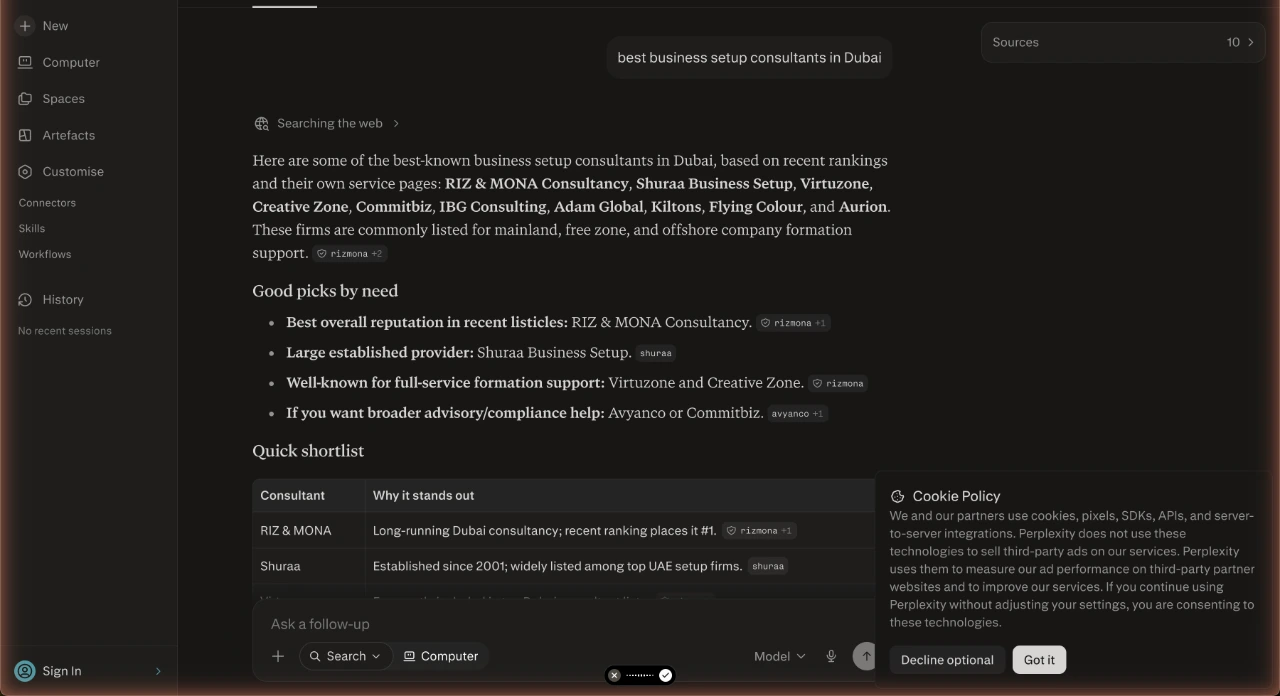
This is the money question. Someone types "best business setup consultants in Dubai" because they are ready to hire and they want a shortlist.
The engine answers by naming businesses.
Here is Perplexity on that exact question. It names a row of firms, and the little source chips underneath tell you where it got them.
Now the same question in Google AI Mode. Different names come up, but look at the sources panel on the right, because that is the real lesson.
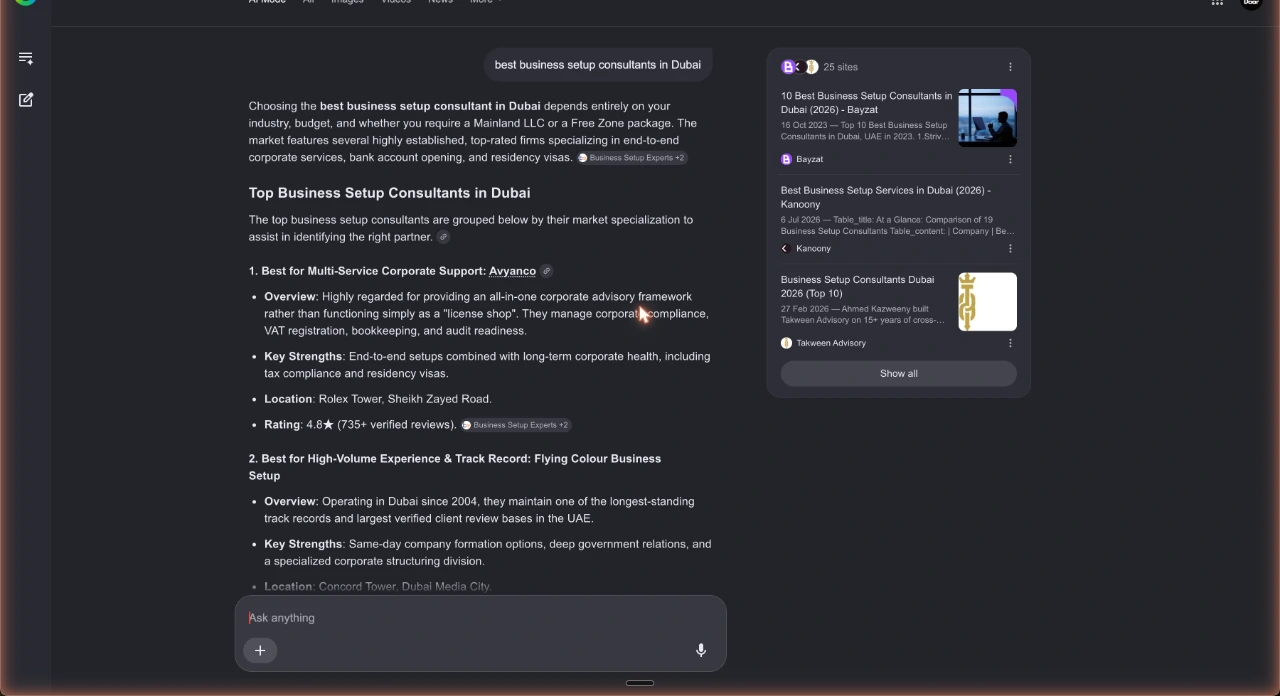
Read those source titles again. "10 Best Business Setup Consultants in Dubai 2026".
"Top 10". "Best Services 2026".
The engine did not read each firm’s website and rank them itself. It read pages that had already done the ranking, and repeated them.
Here is the part that should change how you think. Some of those ranking pages are published by the very firms that appear at the top of them.
A consultancy writes its own "top 10 in Dubai" page, puts itself at number one, and the engine cites it as if it were a neutral referee.
That is not a trick you should be shocked by. It is the structure of this economy.
Commercial "best" questions are answered from lists, so the businesses that get named are the ones who appear on lists, and the fastest way onto a list is to be genuinely worth listing and, honestly, to publish one yourself.
Economy two: the topic question
The second economy runs on completely different fuel. Here someone asks a how or a which question.
"Mainland versus free zone company in Dubai, which is better." They are learning, not buying yet.
Watch what the engine does. It does not name a single business as the answer.
It explains.
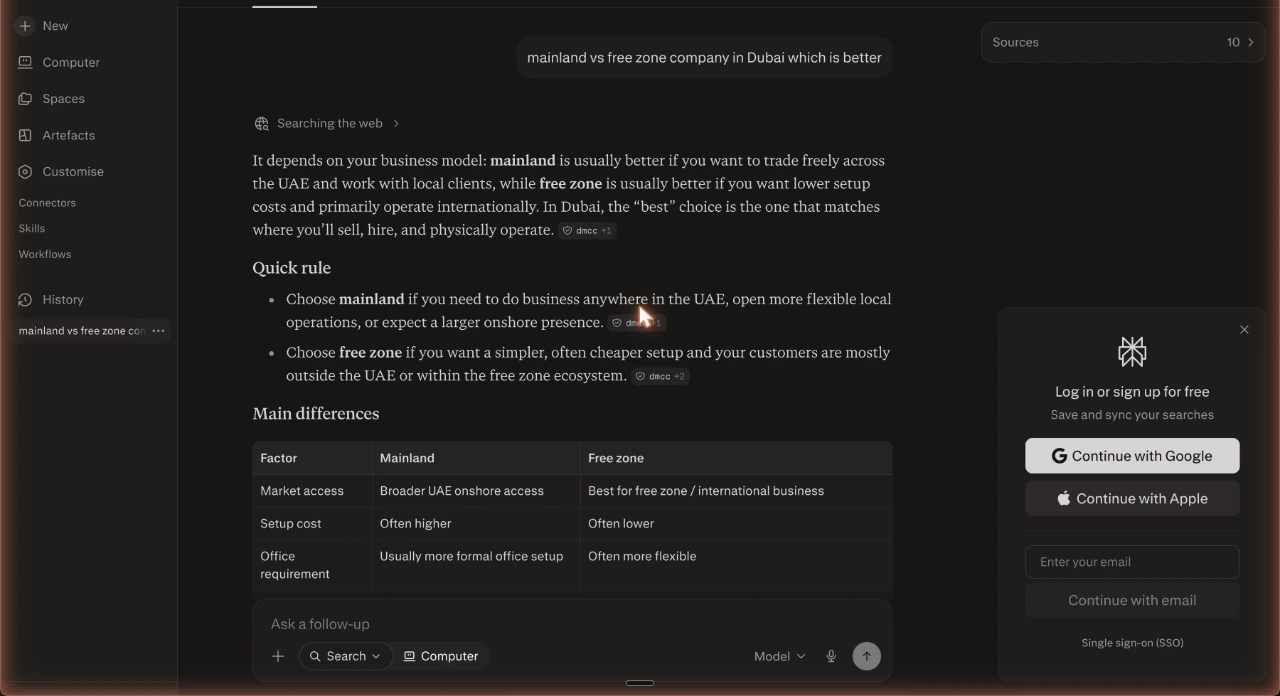
Google AI Mode does the same thing on the same question. A neutral explanation, a comparison table, and sources that are guides rather than directories.
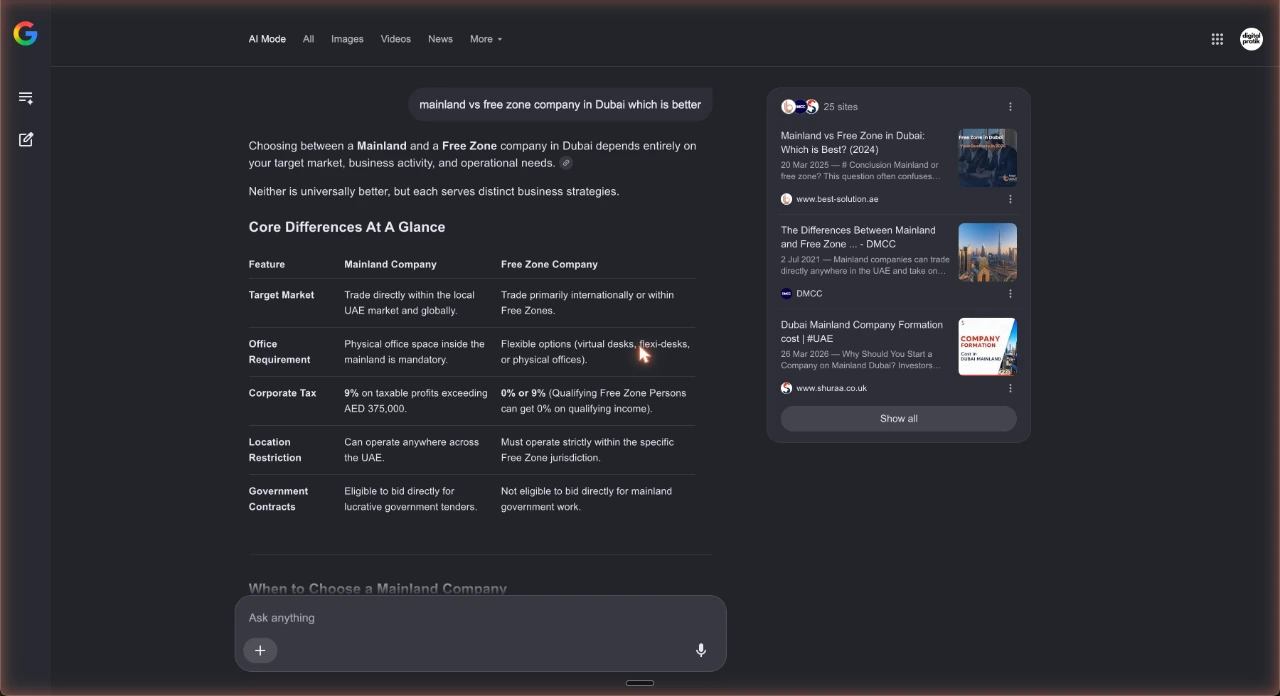
Look at who got cited on that topic question. Mostly the official bodies and a couple of guide pages.
But notice one consultancy slipped in, not because it was on a "best" list, but because it wrote the clearest cost guide on the subject.
That is the door into economy two. You do not get named as the answer.
You get named as the source the answer was built from, and you earn it by writing the single most useful explanation of the topic that exists.
So now you can see why one strategy fails. If you only write helpful guides, you win topic questions and stay invisible on commercial ones.
If you only chase directories, you win commercial questions and never build the authority that makes an engine trust you. You need both, aimed deliberately.
The three levers that actually move it
Underneath both economies sit three levers. Every business that shows up in AI search is pulling these, whether they can name them or not.
I am going to name them, because once you can see them you can work them on purpose.
Lever one: own the topic, not the keyword
You already know the theory from earlier. Here is how you actually do it, and the key word is narrow.
Nobody owns "business setup in Dubai" and you will not either, because it is too broad and the field is enormous. But "company formation for a tech startup in a Dubai free zone" is a much smaller room, and a smaller room is winnable.
This is the move most people get backwards. They go broad because broad feels bigger, and they end up nowhere in a huge field.
You go narrow first, become the obvious answer in the small room, and let the engine promote you outward from there.
It works because of how the machine reasons. When you are named again and again on the specific corner of a subject, the engine builds a picture of you as an authority on the wider subject, and starts reaching for you on the broader questions too.
You win the specific question first, and the generic one is a reward for that, never the starting point.
The practical rule: pick the narrowest version of your topic that still has real buyers behind it, and go and own that completely before you widen an inch. Depth in one place beats a thin spread across ten.
Lever two: information gain, or say what the AI does not already know
This is the lever almost everyone misses, and it is the most important one. An engine has no reason to cite you if everything on your page is already inside its own head.
Information gain is the gap between what the AI already knows and what you are adding. If your article on a subject only restates the standard advice the model could write itself, you have added nothing, and a source that adds nothing does not get cited.
It gets ignored, politely, forever.
I have read businesses with a hundred well-written articles that get almost no AI visibility, and the reason is always the same. Every number in every article is public consensus the engine already had.
There is not one sentence that came from that business’s own experience.
So the question to hold over every piece you publish is brutal and simple. What is in here that the AI could not have said without me?
If the answer is nothing, you have written a summary, not a source.
What counts as information gain is not exotic. It is the stuff you already have and never publish.
Your own numbers, from your own work. The exact process you follow, written down, with the thresholds and the steps nobody outside your business has seen.
A real example of the shape, using round numbers you would replace with your own. "Across the last 40 company formations we handled, the mainland route took on average 11 working days and the free-zone route took 6." No consultancy publishes that.
The moment one does, it becomes the source an engine reaches for, because it is the only place that number exists.
Publish the thing you think is too inside-baseball to share. The protocol, the checklist you actually use, the real timeline, the honest cost breakdown with the fees nobody itemises.
That is the raw material of a citation, and your competitors are all sitting on theirs, too nervous to post it.
Lever three: off-site corroboration
The third lever is the one that quietly decides everything, and it is almost entirely off your own website. It is whether the rest of the internet agrees with you.
An engine does not take your word for what you are. It cross-checks.
Your website says you are the specialist in a thing, and then it looks at your reviews, your directory listings, the roundups you appear in, and it sees whether they say the same thing.
If they match, your claim is corroborated and the engine believes it. If they do not, the engine believes the crowd, not you.
This is the trap that catches good businesses, and it is worth a real example.
Picture a firm whose website is all about serving ambitious founders and fast-moving startups. Now picture its reviews, where hundreds of happy clients wrote words like "friendly", "helpful" and "good service", and almost nobody wrote "startup" or "fast".
The site claims one identity. The reviews describe another.
The engine reads both and sides with the reviews, every time, because reviews are what other people said and your site is what you said. So the firm keeps getting described as a nice general service, and never as the startup specialist it actually is.
The fix costs nothing and almost nobody does it. You change how you ask for reviews, so that happy clients naturally mention the specific thing you want to be known for.
Not scripted, just prompted: "if you are happy to, mention what you came to us for." Do that for sixty days and the language in your reviews shifts, and the engine’s description of you shifts with it.
Corroboration is also why directory listings and honest roundups matter so much. Every place the same true claim about you appears is another vote the engine counts.
Your site is one voice. Corroboration is the choir, and the engine trusts the choir.
There is a fuller version of this idea in proof beats promise, because it is the same principle working in a different room.
Reading about a system and running one are different jobs. If you are a founder doing $50k a month or more, this is what a working session looks like.
How to diagnose where you stand today
You cannot fix what you have not measured, and almost nobody has actually measured this. Here is the exact method, and it costs you nothing but twenty minutes.
Open a fresh private session so nothing about you is remembered, and do not share your location. You want to see what a stranger sees, not what the engine already knows about you personally.
Now ask two kinds of question and keep them separate. The first kind is a discovery question, where the person does not know you yet.
"Who is the best [your category] in [your city]." The second kind is an identity question, where your name is already typed in. "What is [your business]."
Record two numbers and only two. How many discovery questions named you, and how many identity questions named you.
That split is the entire diagnosis in two figures.
Almost every business finds the same painful result the first time. Strong on identity questions, because the engine can look you up, and a flat zero on discovery questions, because it has no reason to recommend you.
That zero is the number the whole exercise exists to move.
While you are there, do the thing that matters more than the score. Read who did get named, and read the sources the engine cited.
That list of sources is your to-do list, because it is literally the set of places the engine trusts on your topic, and you are not in them yet.
Run the same seven questions every few weeks, never daily. The data behind these answers refreshes slowly, so a change inside a week is noise, and only the trend across a month means anything.
More on that when we get to measurement.
How to pick a topic you can actually win
This is where most of the leverage is, and where most people go wrong in the first five minutes. Pick the wrong topic and no amount of good work saves it.
Start with the one-line test from earlier and apply it hard. For every topic you are considering, ask whether an engine would naturally name a business when answering it.
If the honest answer is a general explanation with no business in it, that topic can never make you visible, no matter how well you cover it.
This kills a lot of tempting topics, and it should. "How to recover from a sports injury faster" feels like a great subject, but no engine answers it by naming a clinic.
It talks about rest and load and sleep. You could own that topic completely and still never be recommended, because the question does not want a recommendation.
The topics that make you visible are the ones shaped like a market. A category plus a place, or a category plus a specific need.
"Best [category] in [city]." "[Category] for [specific situation]." Those are the questions where the engine reaches for a name, and where being that name pays.
Then narrow, using lever one. Take the market-shaped topic and cut it down to the smallest version that still has buyers.
You are looking for the room where the field is weakest and your claim is strongest, and that room is almost always more specific than you are comfortable with.
Here is the encouraging part. In most markets nobody owns this ground yet.
When I mapped the Dubai example, even the leader was winning only a fifth of the mentions in a scattered field. A zero-to-leader gap of twenty points is a very different fight from chasing someone who owns eighty percent, and most local markets look like the former.
This ties directly to picking the one problem you actually solve, which I wrote out in the 3A Machine.
Build the assets the engines actually cite
Now you know the topic and the economy. Here is what you actually build, in the order that gets you cited fastest.
There are four assets and they are not equally hard.
The honest roundup
This is the asset for economy one, and it is the fastest win most businesses are ignoring. You write the list that the engines cite on commercial questions, on your own site.
The instinct is to write "top ten [category] in [city]" and put yourself at number one. Do not.
A transparent advert gets read as an advert, by people and increasingly by engines, and it does nothing for a business whose whole edge is being trustworthy.
The version that wins is narrower and genuinely honest. Pick the specific slice you actually lead in, and write the real comparison for that slice.
Name your real competitors, with real reasons someone would choose each of them, and state your selection criteria at the top so it reads as a method and not an opinion.
A list that reads as a fair comparison gets treated as a source. A list that reads as a sales page gets treated as noise.
The honesty is not a nicety here, it is the thing that makes the asset work.
Original data
This is lever two made physical, and it is the single biggest unlock available to almost every business, because so few use it. You publish a number that exists nowhere else.
It does not need to be a research paper. It is the data you already generate and never share.
Your average timelines, your real success rates, the distribution of outcomes across your last fifty clients, the actual cost breakdown of the thing everyone quotes vaguely.
Publish it plainly, with the method stated so it is credible, and no client identified. This is the piece that will move your visibility fastest, and it is the piece that needs you personally, because only you have the data.
Everyone can write a guide. Only you can publish your numbers.
Proper author attribution
The engines are trying to work out whether a real, qualified person stands behind your content, so tell them clearly. Put a named human on it, with real credentials, consistently, across everything.
This is not a byline for decoration. It is a signal that ties your content to an expert the engine can verify elsewhere, on the professional networks and the profiles that corroborate the claim.
A named expert with a consistent identity across the web is far more citable than an anonymous "team" or "admin".
And keep that identity identical everywhere. One spelling of the name, one description of what they do, the same across your site, your listings and your profiles.
Mixed signals make the engine unsure it is the same person, and an engine that is unsure does not cite.
The topic hub
The last asset ties the others together. If you have a pile of articles on a subject with nothing connecting them, the engine sees a pile of pages.
If you have one canonical page on the subject that links out to all of them, the engine sees a body of work with an owner.
Build the pillar page for your narrow topic, and cluster every related piece under it. That structure is how you turn ten loose articles into one visible authority, and it is the difference between looking busy and looking like the source.
How to measure whether any of this worked
Measurement in AI search is where people fool themselves, in both directions. They panic at a bad week or celebrate a good one, and both are usually noise.
Here is how to read it honestly.
The manual method is the fresh-session test from earlier, run on a schedule. Same questions, same conditions, every two or three weeks, tracking your two numbers over time.
It is free and it is real, and it is enough to start.
There are also tools now that track your AI visibility for you, across the engines, on a set of prompts you define. They give you a visibility percentage, a share of voice against competitors, and a view of which questions you are named on.
Useful, as long as you read them correctly, and most people do not.
Three rules keep you honest. First, the data refreshes slowly, usually weekly, so there are only about four real readings in a month, and anything that looks like movement inside a week is noise.
Second, each score often rests on just a couple of AI answers per question, which is a small sample, so single-point swings mean little. Third, judge the trend across three or four cycles, never a single week.
One more discipline that saves you from chasing ghosts. If a tool is scoring you on questions that no engine would ever answer by naming a business, those questions will always read as zero, and they will drag your average down while telling you nothing.
Score yourself only on questions where a name is a valid answer. Everything else is measuring the wrong race.
And set the expectation correctly, for yourself and anyone you report to. Content needs to be crawled before it can be cited, and the data moves in weeks not days.
Real movement on AI visibility is a sixty to ninety day story. Anyone promising faster is guessing.
Do this on Monday
Enough theory. Here is the order to actually start in, and none of it needs a budget.
You can do the first five before lunch.
- Run the fresh-session test. Open a private window, ask the five discovery questions a stranger would ask about your category, and write down how many named you. That is your baseline.
- Read the sources, not just the answer. Note every site the engine cited. That is your target list of places to get into.
- Apply the one-line test to your topic. Would an engine name a business when answering it? If not, narrow it until it would.
- Pick the narrowest winnable version of your topic. Category plus place, or category plus a specific need. Small room, real buyers.
- Write down one number only you have. A real average, rate or timeline from your own work. This becomes your first piece of original data.
- Draft the honest roundup for your slice. Name real competitors, real reasons, real selection criteria at the top. No self-promotion at number one.
- Fix your review ask. Prompt happy clients to mention the specific thing you want to be known for, so your reviews start corroborating your site.
- Check your listings and profiles match. Same name, same description, same claim everywhere. Kill the mismatches.
- Put a named expert on your content. Real person, real credentials, identical across every page and profile.
- Book the re-test for three weeks out. Same questions, same conditions. Judge the trend, not the day.
What this will not do
A few honest limits, because the field is full of people pretending there are none. AI visibility is powerful and it is also slow, and it does not fix everything.
It will not work overnight. Nothing here moves the needle in a week, and if a tool shows a jump in seven days, distrust it.
This is a sixty to ninety day build.
It will not save a business nobody would recommend anyway. The engines are reading real reviews and real signals, so if the underlying experience is weak, corroboration works against you.
Fix the business first, then the visibility follows.
And it will not replace the rest of your marketing. AI search is one channel among several, and it feeds the top of the funnel, not the whole thing.
Treat it as one strong new way to be found, built on top of an offer and a follow-up that already work.
The one thing to take away
Stop trying to rank and start trying to be cited. The businesses that win AI search in 2026 are not the ones with the most pages, they are the ones the engines trust enough to name.
You earn that trust three ways. You own a narrow topic completely, you publish the information nobody else has, and you make sure the rest of the web says the same thing your site does.
Do those, patiently, for a quarter, and you stop being the business the engines recognise and start being the one they recommend.
Go run the fresh-session test today. Whatever number it gives you is the truth about where you stand, and the truth is where every real improvement starts.
Frequently asked questions
AI search visibility is whether engines like ChatGPT, Perplexity, Google AI Mode, Claude and Gemini name your business when they answer a question. Old SEO was about ranking a page for a keyword. AI visibility is about being the source the engine cites inside a written answer, which it decides by reading your whole reputation across the web, not just one page. You are building a citable authority, not climbing a list.
Own one narrow topic instead of a broad keyword, publish information the model does not already have, such as your own real data and processes, and make sure your reviews, listings and the roundups you appear in all echo the same claim your site makes. Being recognised when your name is typed in is easy. Being recommended on a discovery question is earned through those three levers over about sixty to ninety days.
They are the two different ways engines choose sources, decided by the question. Commercial "best X in Y" questions get answered by naming businesses, and the engine pulls those names from list-shaped and directory pages, often ones the businesses published themselves. Topic and how-to questions get answered by explaining, and the engine cites the clearest guide on the subject without naming a business as the answer. You need a different asset for each, aimed on purpose.
Plan for sixty to ninety days before you see real movement, not days. New content has to be crawled before it can be cited, and the data behind these tools refreshes roughly weekly, so there are only about four real readings in a month. Anything that looks like a jump inside a single week is almost always noise. Judge the trend across three or four cycles.
You can check it yourself for free. Open a fresh private session, ask the discovery questions a stranger would ask about your category, and record how many name you and which sources the engine cited. Paid trackers add a visibility percentage, a share of voice against competitors and prompt-level detail across engines, which is useful at scale, but the manual fresh-session test is enough to get an honest baseline and start.
Install this in your business
An article gives you the map. A working session gives you the system, built around what you actually sell and who actually buys it.