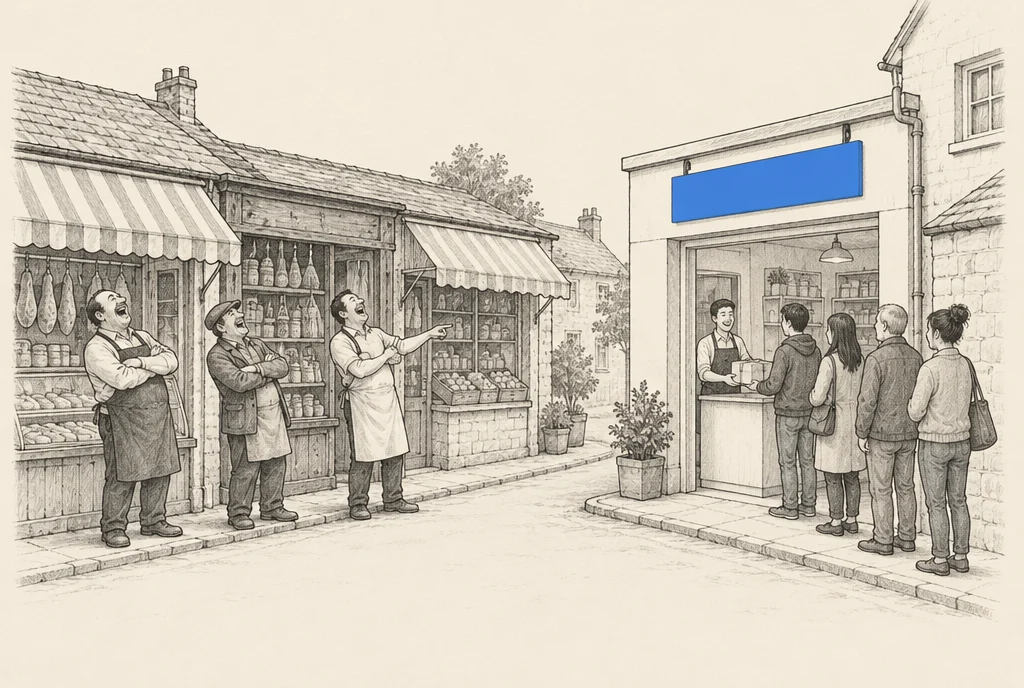
The ghost payroll that eats your margin. You pay for it every month.
Your team is busy all day. Sales are fine. But the profit at the end of the month is thin, and part of the reason never shows on the salary sheet.Your team is busy and sales are fine, but the profit is thin. Part of the reason never shows on the salary sheet.

- Ghost payroll is the paid hours your team spends on work nobody asked for, or work that should not exist.
- It hides in 5 places: chasing, retyping, waiting for you, redoing and status meetings.
- You can find it in 1 week with a plain time log and 1 question: what did you do twice?
- Remove it 1 step at a time. Then decide if you still need the new hire.
In this article
Most owners I talk to in Dubai say the same thing. The team is busy. Nobody is lazy. Sales are coming in. And still, at the end of the month, the profit is thinner than it should be.
So they look at the salary sheet. It shows names and amounts, not hours. It cannot tell you that 1 person spent half of Tuesday chasing a file that was already in the shared folder.
That is what I call the ghost payroll. It is the paid hours your team spends on work nobody asked for, or work that should not exist at all. The person is real and works hard. The hours are real too. But nothing in the business moves because of them.

This is not about catching anyone. It is almost never the person's fault. It is a step nobody designed, so people fill the gap with effort.
Every salary should own 1 result. The ghost payroll is the part that owns nothing.
01Find it in 1 week, with a pen and a sheet
This is bigger than most owners think. Asana's Anatomy of Work Index 2021 asked over 13,000 office workers in 7 countries how they spend their day. 60% of it went on work about work, not the skilled job they were hired to do.
- 60%of the day went on work about work
- 157ha year lost to unnecessary meetings, per person
- 13,000+office workers asked, in 7 countries
That study was not about Dubai, and your firm is not an average. So find your own number. It takes 1 week and no software.
The plain time log
- 01Monday: explain it first
Tell the team this is about the work, not about them. Nobody gets blamed for what the sheet shows.
- 02Every day: write the hours
Each person writes what they did, hour by hour, in plain words. 1 line per hour is enough.
- 03Friday: mark every line
Next to each line, write real or ghost. Real work moves a client, a sale or a delivery forward.
If a full log feels too heavy for your team, use the short version. On Friday, sit with each person for 10 minutes and ask 4 questions.
Ask each person
- What did you do twice this week?
- What did you wait for, and who were you waiting on?
- What did you type that was already written somewhere else?
- What did you redo, and why?

When you read the answers, the same few things come up again and again. In the service firms I look at, the ghost usually hides in 5 places.
Where the ghost payroll hides
- 01Chasing
Asking for the same file or answer twice.
- 02Retyping
Copying what came on WhatsApp into a sheet by hand.
- 03Waiting
Work that stops until the owner says yes.
- 04Redoing
Doing the job again because the brief was vague.
- 05Status meetings
Sitting in a room to hear updates that could be read.
021/5 Chasing the same thing twice
Here is how it usually goes. A client sends a passport copy on WhatsApp. Someone saves it on their own phone. A week later another person needs it, cannot find it, and asks the client again. Now the client is annoyed, and you paid 2 people for 1 file.

The fix: 1 place where every client file lives, and 1 person who asks for it, once. Ask once, save it once, and everyone looks there first.
032/5 Retyping WhatsApp into a sheet
In Dubai, most of the business happens on WhatsApp. The enquiry, the order, the change, the address. Then someone sits down every evening and types it all again into a sheet or a system.
That is paid time spent moving words from 1 screen to another. It adds nothing, and it is where mistakes get in. A wrong number typed at 7 in the evening becomes a wrong delivery the next day.
The same order, 2 ways
On WhatsApp
On WhatsApp
A person, every evening
A machine, as it comes in
A wrong digit slips in
A person checks, not types
Every order, every day
Only the check
Let a machine catch the message and fill the sheet. A person checks it. Nobody types the same words twice.
043/5 Waiting for your yes
This one is about you. If every discount, every change and every small decision needs your yes, then your whole team waits every time you are in a meeting, on a flight or asleep. They are paid while they wait, and they learn not to decide anything.

The fix is a short rule. Write down the few things that still have to reach you.
What still comes to you
- Money above a line you set.
- A client who is about to leave.
- A hire or a fire.
Everything else gets a named owner who is not you, and that person decides. They will get a few small things wrong. That costs less than everyone waiting for you.

054/5 Redoing work after a vague brief
The owner says "make it look better" or "send them something nice". The team guesses. The owner sees it and says "not like this". The work gets done again, sometimes 3 times.
Every round is paid. The problem was never the team. It was the brief. Say what good looks like before the work starts.
A brief in 4 lines
- What is it for?
- Who will read or use it?
- What does done look like?
- When is it needed?
If you cannot answer those 4 in 2 minutes, the job is not ready to hand over.
065/5 Status meetings
A weekly meeting where each person reads out what they did. 8 people for 1 hour is 8 paid hours, to hear things that could be read in 2 minutes.

Keep meetings for decisions. Move the updates into writing.
Updates without the meeting
- 013 lines, by 10 in the morning
Each person writes in the team group: what I finished, what I am doing, where I am stuck.
- 02Read, do not discuss
Nobody replies unless they can help with the stuck part.
- 03Meet only to decide
If something needs a decision, book 15 minutes with the people who decide.
07Remove it 1 step at a time, before you hire
When a team feels busy, the first idea is to hire. But if you hire into a broken step, the step is still broken. Now it also costs a salary. Hiring to fix the ghost only adds more of it.
Sometimes the ghost is not a few hours. It is a whole role. Write every role on 1 page, and next to it the 1 result it owns. If you cannot write one, that role was never defined.
Take the ghost out, 1 step at a time
- 01Pick the biggest ghost
From the Friday sheets, take the 1 that ate the most hours. Only 1.
- 02Fix the step, not the person
1 owner, 1 place, 1 rule written once in plain words.
- 03Then let a machine help
Only now add automation or AI, so it runs the fixed step and not the broken one.
- 04Log 1 more week
Run the sheet again. If the hours came back, the step is not fixed yet.

Do this before you post the job ad. Often the hire you were sure you needed is not needed any more. And if it still is, you are hiring into a step that works.
On Monday, give every person a plain sheet and ask them to write their hours for 5 days. On Friday, ask each one: what did you do twice?
08Questions, answered
Will my team feel watched if I ask for a time log?
They might, if you skip the first step. Tell them it is about the work, not about them, and keep your word.
How is ghost payroll different from a lazy employee?
A lazy person avoids work. Ghost payroll is hard work spent on the wrong things. Most of it comes from steps nobody designed.
Should I let people go after I find it?
That is not the point. The point is to give those hours back to real work, like clients and delivery.
Can software fix this for me?
Only after the step is fixed. Software runs a broken step faster. Fix the step by hand first, then let a machine run it.
If you want to see where the hours go inside your firm, that is one of the things the Capacity Diagnostic looks at.

Digital PratikA 37 year old, smiling, practical Gujarati, a Kathiyawadi businessman. Founder of JorrDaar LLC, Dubai.